Friday, October 30, 2015

Being rich in Napa Valley: Thank God for Uber

I'm working on a new book about Napa, the third and final volume of my trilogy about a unique (and sometimes unwitting) experiment in American agriculture and the achievement of the American dream. Here's one of an on-going series of reports from the road.                                                                  
      The drive sweeps steeply upward to a glass and steel amalgam of a house with no readily apparent entrance. Patterned squares of stone set about with low sprawling ground cover hold all this together visually. There is a metal panel beside a door, however, with a speaker, a dark vertical screen, a cavity that looks like it might be for reading fingerprints, a built-in computer keyboard, and a discreet metal plate bearing the impression of a bell.
   I press it, but no response. I take out my cell phone and send the house’s owner a text: I am outside.
   Wind carries up the valley, pushing shrouds of cloud but no rain in this, the biggest fire season ever. A walk around the outside - one can’t easily circumnavigate this house, recently assessed at $100 million - reveals more stone sheathing, glass, sod roof, and a lower postage stamp lawn as green as a dream, sprawling ground cover and deep calm out of the wind. On the upper level are four impervious metal garage doors, but no sign of an entrance or a human being. It’s a bit like gazing into a vast, multi-faceted aquarium devoid of fish.
   I am being hailed. A middle-aged man in a red knit shirt and stocking feet gestures, and I go up to him. We shake hands. “Joe,” he says, as if it’s my name, not his. He adds, “This is a shoeless house.”
   Indeed, the sculpture in the entranceway is a brutal composition of fine English leather shoes skewered by sharp wooden spikes, a strong incentive for the visitor to listen to his host. The floors are stone, too, cool even in September, and the house seemingly large enough to wear out a pair of socks if you walk from one end to the other.
   We descend stairs to the broad living room beyond which the southern reaches of Napa Valley seem submerged. Joe leads the way into what looks like a cramped metal galley in a ship, though this one has no apparent crew, opens a locker and takes out a black $100 bottle of Silex, the Pouilly-fume from the upper Loire.
   “I don’t drink California wines,” says Joe. “I asked Aubert de Villaine” - a co-owner of Romanee-Conti - “how old his oldest vines are, and he said fifty-five years. We don’t have anything like that here.”
   The Silex is indeed clean, complex, lively. We sit on separate couches in front of a dead fireplace. Summer’s over, winter still a ways off. Joe crosses his legs. His face is long, his dark eyes inquisitive, but he’s in a hurry, having, as he put it on the phone, “a hard stop at 6:20” and it’s already a quarter to.
   Joe came to Napa for the first time in 1966 “and made it a point to get to know the people and to reach out to those who would be my neighbors.” Getting his permit for this house took years and required - in his view - digging a cave in the mountain and filling it not with wine but with ten thousand gallons of water, “the basis for all our heating and cooling, all by mother nature. It made no financial sense because of the cost,” adding with a laugh, “I belong to the point one percent, and I feel good for being green. But when I’m in board meetings with Al Gore, I get tired of it. I can’t count the number of times he says, ‘Carbonization.’”
   St. Helena was indeed the poster child of California small towns when he decided to build his house just outside the city limits. He also owns a stunning retreat and even better wine cellar - he’s on the advisory board of Soutirage - on the coast in Big Sur, and other houses in various parts of the world, being an early rider of the dot-com syncline (Hewlett-Packard, Apple, Accel) as it burst through California’s cultural crust thirty years ago. Today he belongs to the World Economic Forum, was a regular at Davos and a man of some global reach and influence, yet in his way indicative of many in little St. Helena.
   Joe has lived in the neighborhood so long he has, for California, something close to a historic view. The most important local figure in it, in his opinion, is the deceased former mayor, Delbert Britton. “Del had one fundamental, fatal belief: he wanted to pour hot wax over the town and preserve it. I told him he could either grow it, or shrink it, but it would take magic to keep it the same.”
   Joe believes St. Helena’s fiscal problems are directly related to thwarted growth, or the failure of some draconian vision whereby the town would be converted years ago into the equivalent of a gated community. “Now the leaders have panicked and are breaking glass,” a powerful metaphor in this gorgeous transparency, by which he means officials are trying to open the place for business in any way possible, despite the fact that many of the citizens don’t want that.
   We are close to the hard stop. The primary concern of the rich at the end of day seems much the same as that preoccupying their ancestors back in the Pleistocene: not low income housing nor a new police station nor re-paved streets, but dinner. “The most difficult question to answer in St. Helena is, ‘Where are we going to eat?’ You have to go down to Yountville, or Napa, for a really good meal. The only solution to that problem is Uber.”

Tuesday, October 13, 2015

The Far Side of Eden 19: Something had happened...

Note: This posting from my second Napa book, The Far Side of Eden, is the last of a series. Earlier postings can be found in the menu to the right, starting in June 2015.


      SOMETHING momentous, something involving money, lots of it—what didn’t at century’s end?—but more complicated and subtle. It pervaded the lives of Americans considered blessed by any standard, with houses close to some of the best restaurants on earth, the value of their property on a near-vertically ascending plane, their views of a gorgeous pastoral dream: mountains, agriculture as old as human history, wild mustard blooming in the spring and, in autumn, the air perfumed by fermenting wine as precious as that of Bordeaux, Burgundy, and Champagne.
      San Francisco lay just across a sparkling inland sea, but the finest things could be had right here, too, at stations of the new cross—truffles at Sunshine Market, demi-glace at Dean & DeLuca. Appetites were enhanced by the best weather in a state famous for it, and the proximity of visiting Hollywood and other sorts of stars imbued existence with a certain frisson. And even if there were five million tourists a year to deal with, well, those already here in the Napa Valley were the envy of all who weren’t.
     Yet something was wrong. People disagreed over when “it” had happened, and why, but not about the effect: a real, and growing, sense of loss. They felt it while sitting in a long line of cars on Highway 29, looking up at once pristine slopes dense with conifer and chaparral, studded now with “steroid houses,” “muscle houses,” “McMansions,” all contemptuous names for places built not to live in but as monuments to finance, visited by absentee owners. The locals felt it overhearing conversations about vanity vineyards, “cult” cabernets, and gardens with “water features” to cover the traffic noise.
      If they wanted to buy a house to actually live in, or to trade up, they had to listen to sales pitches not about the valley’s illustrious history, its neighborliness, schools, and churches, all the old-fashioned values, but about the proximity of Tra Vigne and the French Laundry. If they owned a house already, they had to wait for a carpenter or a plumber because these tradesmen worked for the owners of the muscle houses or redone Victorians, and then the locals had to pay fees often inflated by the presence of so much outside money.
      Worst of all, they had to listen to the stories. Many of these featured limousines but were otherwise interchangeable. “I was pruning my roses when this couple gets out,” began one such account. “He’s got on wraparound shades and a five-hundred-dollar shirt with not enough buttons, bought in Beverly Hills, and she’s wearing haute safari from wherever.”
      The visitor might also be driving a new Lexus and looking nerdy in pressed jeans and granny glasses, sure sign of a Silicon Valley weekender. These were the young beneficiaries of the computer boom, and realtors referred to them as “the children.”
      The procedure was much the same: “He says, 'I’ll give you . . .,'” and here the figure varied among the millions, but was never less than one. “I tell him the house isn’t for sale. He doubles the price. I have to go inside to get away from him.” Later, the visitor calls and triples the offer.
      The problem was, many of the stories were true, like the one about the house that sold for one-point-three, already an amazing sum for such a modest place, and then the new owners “tweaked” the landscaping—added some exotics and a stone wall—and sent to France for a containerful of furniture. They put the house back on the market for two-point-nine-five and received three instant offers for more. During escrow, an unsuccessful bidder offered the buyer point-five just to step aside—half a million dollars to get out of the way.
      There was the house listed for four, bought by a venture capitalist who had seen it only once. Upon seeing it a second time, he decided he no longer fancied it and resold the house at a half-million-dollar loss to a thirty-five-year-old working in the acquisitions department of a major bank. And there was the cottage in the town of St. Helena, listed for point-nine-two-five, bid up to one-point-three. After that, everybody with a three-room Victorian guesthouse with one and a half baths thought it was worth one-point-three, and it was.
      Houses that were not for sale were auctioned off without the knowledge of the owners, who were presented with offers as faits accomplis. Weekend guests bought their hosts’ residences. One such couple reportedly paid millions, first stipulating that everything had to be left as it was, right down to the terrycloth bathrobes, since they didn’t want to be bothered with purchasing their own things or didn’t know what was required. Not that it mattered.
      Experts materialized to perform that function for the newcomers, many of them living in San Francisco and tripping up on commission. They advised on the creation of cunning archways, the buying of period settees or Mayan urns, the planting of herb gardens “with a culinary bias,” the buying of wines from the Oakville Grocery, the joining of Meadowood Country Club, the ordering of cut flowers from Tesoro’s, the hiring of chefs and the vetting of maids and valets and the planting of the ultimate symbol of success, more important even than a house—a vineyard of one’s own.
      Everybody who mattered suddenly had to have one. This link to ancient tradition was the latest, best way of transforming money into status, though what the newcomers really wanted was a vineyard and “a cabernet” made from its fruit that would be highly ranked by the critics and set them miles ahead of other merely wealthy people. The locals couldn’t afford these wines but had to listen to weekenders talk about them.
      And they had to listen to the story about the woman with a vineyard of her own who sold her mauve Bentley because it had no rack for holding lattes, and the story about the couple building a glass house containing smoke machines, and the story about another couple with monogrammed toilet paper, each square resembling an illuminated manuscript. You laughed at the stories, but they had an effect.
      Life began to feel like a lottery, or like Renaissance Spain, the gold ships coming in and their sails overshadowing all past custom and convention. Their modern equivalent was the stretch limo, the pilot fish of the nouveau riche lurking in restaurant parking lots and in the shade of olive trees on landscaped lawns.
      Much of this bullion had been mined down in the Santa Clara Valley, once lovely orchards since paved over and rechristened with that unlovely moniker Silicon, symbol of the greatest economic expansion in human history, a chemical that transmitted electronic impulses and churned assets, changing the world, spinning off money to computer whizzes and venture capitalists, dot-commers, “IPO sluts,” entrepreneurs, investment bankers, retailers, media- and consumer-related accumulators of capital, all belted to the marvelous economic engine of the fading American century. And not a few of them were disciples of personal gratification, and self-serving.
      There were the speculators, a category to which every winery owner and, in fact, many householders now belonged. That fact alone was galling. With the acceptance of it came another realization, even sadder, that in a few short years many longtime residents had gone from being members of a community to serving as its adjuncts.
      So many of the big old houses now belonged to outsiders the locals were unlikely to get to know, and so eventually, it seemed, would all the valley. These old-timers would be performing some service for the new people, if they weren’t already, even though the locals were relatively rich on paper. If one of them sold a house or a little vineyard, he couldn’t afford to buy another, not “up-valley.” He couldn’t compete at the wine auctions that raised money for the schools and hospitals, couldn’t get a new kitchen countertop put in, couldn’t get a table at Bistro Jeanty or even at Green Valley CafĂ© because of all the tourists drawn by the celebrity.
      Things were out of whack, not just in the real estate offices but also in the hills. Out of sight, larger muscle houses were being built, and caves dug to gargantuan dimensions to contain activities not related to wine, and outlandish embellishments put in. There was the persistent story of a canal built on a high dry ridge, complete with an operating lock and a barge that could be boosted up and down, this in a fragile place where water was scarce. Some people thought this a charming diversion, and others thought it disgusting ego gratification and bad taste, but they didn’t say so because for the most part people in the valley were accepting souls, polite, reluctant to criticize.
      This was just another story, no worse than the one about the woman who moved from the Midwest to a house in the hills costing millions so she could make cheese and sell it to the CIA—the Cu linary Institute of America. Thus a substance once the byproduct of mere agriculture had been elevated to a symbol of culture. For the first time in human history, people were spending fortunes to make chump change and in the process be associated with the most basic sort of enterprise—agriculture—which in this incarnation had become glamorous.
      It made no more economic sense than the muscle houses and vineyards on steep land where forest had stood, and people marveled at the cost of it all. Planting those steep slopes cost upward of a hundred thousand dollars an acre just to get the vines in, not counting the purchase price, unjustifiable on the economics, not arrived at by trial and error, as in the old days, but simply ordained, bought, and written off.
      There was no space left on the valley floor for such “vanity” vineyards, but they had to go in somewhere, for the social and financial enhancement they promised, and that meant the hills. The visible new vineyards and muscle houses amounted to a fraction of what was going on out of sight, or so it was said; in the rainy season, development high in the Mayacamas and the opposing range to the east tinged the reservoirs of drinking water and turned the Napa River murky.
      There was too much happening up there for most people to keep track of and still live their lives. More and more of them worried about what it all meant, where it was all going, what was being lost.
                                                    *                                                


To order the first book, Napa,  go to:

To see my bio, click on:

Sunday, October 4, 2015

The Far Side of Eden 18: Eco-zealots?

Note: This series of excerpts from my second Napa book begins with the June 2015 postings in the menu to the right.                                                         
                                       
      Jayson Pahlmeyer’s answering machine informed callers: “This is Jayson. Please leave a message while I uncork a powerful Pahlmeyer merlot.” His travel schedule brimmed with wine promoting events, his bank account with the proceeds, his large presence—- slicked-back hair, new Dickensian eyeglasses—with confidence, but increasingly he found himself talking penance.
      He was no longer just a fine wine producer and owner of a capital-inhaling new vineyard, he was the object of a lawsuit by one of the most powerful environmental organizations on the planet, one started by a saint of nature lovers, John Muir, who had attempted to prevent the construction of the Hetch Hetchy Dam in the Sierras and the despoiling of Yosemite and other pristine places. The club had hundreds of thousands of dues-paying members, and he imagined that they were all mad at Jayson Pahlmeyer.
      The lawsuit had effectively shut down all new agricultural projects in the hills and brought new condemnation of Jayson, but also some grudging sympathy: some vintners had decided that their enemies’ enemy was their friend. “I planted what was already a cow pasture,” Jayson repeatedly told them on the telephone, at Vintners Association meetings, at Mustard’s, “and what’s lost in all this is that I didn’t cause any damage!”
      If his story was made into a movie, he thought, it would go like this: Cult vintner brings secret grape clones to the United States and makes a notable success. He raises money and tells a cowboy to put in a primo rocket-juice vineyard, pronto, at any cost, and is then attacked by eco-zealots. The ending of the film was as yet unclear. Perfectly clear was monoculture-as-villain, along with “alcohol factories,” miracle-grow aristocrats with recently buried pasts in microchips, condo developments and other, less salubrious means of fortune accumulation, and other businessmen, no longer envisioned as daring entrepreneurs but as exploiters and elitists.
      Jayson had been at home the day he heard about the suit. The papers were served at the Pahlmeyer Vineyards office down in Napa, in the revamped industrial section overlooking the Napa River, and his partner, Michael Haas, had telephoned him with the news. Jayson had felt his stomach drop. This was the crowning blow, after all the previous bad publicity, and he saw the future unfolding, as he had been trained to do as a lawyer, with many possible outcomes of the lawsuit, few of them entirely beneficial and none pleasant.
      What really scared the vintners were the words “moratorium” and “radical setbacks.” The suit would add fuel to those fears. A legal end to planting in the hills, to clearing and planting within a few hundred feet of streams, would mean suffering serious opportunity and capital losses and the personal effrontery of the have-nots.
      Another hated word was “restoration.” Returning vineyardland to wildlife habitat sounded less than draconian to the average American, but not to vintners who were outraged by the lawsuit. Their shared pain gave Jayson some comfort. Wines like his were still the driving consideration among present and aspiring vintners, cult labels contributing to the symbiotic relationship among wine, second and third homes, upscale tourism, art collecting, heavy-duty landscaping, and all the elements of the boom that danced bellybutton to bellybutton in the valley, grinding out lucre. In such an environment even slow-growth advocates and old-time responsible farmers were tempted to forget the rules. That was human nature, but the rules were before the public now.
      Jayson had to finish his million-dollar project on the ridge, so close to completion he could taste it. One day it would include a three-level, gravity-flow winery, and maybe a chateau that Chris Malan would have to look at every morning on her way down to Napa. But settling the lawsuit would mean reapplying for an erosion control permit, paying legal costs of the Sierra Club and the county—unless his suit against the county for damages proved successful—and contributing thousands of dollars to some environmental organization stipulated by the plaintiffs.
      That was the most galling suggestion of all those made by the Sierra Club lawyer. Jayson told anyone calling to ask about the lawsuit, “It’s known as extortion,” as he sipped a Pahlmeyer red in one of his blue leather chairs. “There were eighty other vintners like me with hillside projects. Malan and the Sierra Club could have gone after all of them, but they didn’t. Maybe that would have caused too much dissension. Frankly, I don’t know why they picked me. It’s a mystery. I’m the one that got caught in the crosshairs. I feel like a wildebeest singled out from the herd.”
      If he reapplied for a permit to finish his vineyard, “Chris will stand up in front of the board of supervisors and say I shouldn’t get it without an environmental review . . . She’s been able to marshal incredible power as a private citizen. And once they get CEQA, she’ll have her private pulpit. She can take any vineyard granted a permit right back to court.”
      This fear was making its way beyond the mountainous confines of Napa Valley to the halls of the capitol in Sacramento. It raised red flags from Mendocino to Santa Barbara and threatened to do on a large scale what the Sierra Club had failed to do locally: rally environmentalists. Chris Malan was quoted as saying, “California’s in for the fight of our time,” and Jayson felt that the words were directed at him. The boy from Oakland who made a wine to drop you . . . Everybody had heard that phrase by now. But his marketing image was being overshadowed by that of the cult wine producer who let the eco-zealots into Eden.
                                                     *                                               


To order Napa:

Monday, September 28, 2015

The Far Side of Eden 17: Democracy!

Note: This series of excerpts from my second Napa book begins with the June 2015 postings in the menu to the right.                                           


      KATHRYN WINTER received a telephone call from a friend in Napa. This friend informed her that a woman was going around Kathryn’s district saying she was running for supervisor and talking about “saving the hillsides.” Kathryn made some calls and learned that the woman was Chris Malan. She couldn’t believe it. Why would Chris undertake anything so reckless? She telephoned Chris and asked if she was running, and Chris said yes, just to keep the hillside issue before the public. Kathryn asked her to come to her condo off the Silverado Trail so they could discuss the matter, thinking there was still time to get a handle on this.
      A fourth-generation San Franciscan, Kathryn had grown up in the Central Valley and witnessed the destruction of farmland there and near Chico, where she had taught school for a time. She deplored what had transpired around Stanford University, with the proliferation of the computer companies, and didn’t want something similar to happen to Napa Valley.
      Her voting as a supervisor indicated this, but she was an environmentalist with a small e. She had carefully distanced herself from the more radical elements of the movement, and her refusal to appoint Chris to the Watershed Task Force had proven this. The decision irked Chris, but it was done in good faith because Kathryn wanted the task force, an experiment in civic cooperation, to work. Chris’s presence was always polarizing.
      Although Kathryn had supported the moratorium on new steroid houses in the hills, she had refused to oppose all vineyard development up there. She had joined with others in condemning the Sierra Club lawsuit as divisive and potentially damaging. There was so much at stake, not the least of which was Kathryn’s job, and Chris had to be made to understand this.
      She didn’t show up for the meeting. Kathryn was scheduled to go door-to-door canvassing with a local supporter at lunchtime, and had to cancel. That was a squandering of valuable support, but she figured the meeting with Chris was more important.
      The longer Kathryn waited, the angrier she got. Finally Chris arrived, three hours late, having been up in an airplane, leaning out the window taking more photographs of hillside destruction. All over the valley now, whenever people heard or saw a helicopter, they said, “There’s Chris Malan,” and often it was. Cold, tired, in a foul mood, Chris told Kathryn, without preliminaries, “I’m running against Bill Dodd, not against you.”
      Kathryn pointed out that Chris would in fact be running against both of them. Doing so, she would split the environmental vote and perhaps siphon off enough of it to force the election into a runoff. Possibly—unthinkably—she could throw the whole thing to the Chamber of Commerce candidate at the outset. Kathryn assured her that, after the election, she would sit down with her and work out a plan for the watershed, if only Chris would reconsider.
      But Chris didn’t seem to be listening. She said she wouldn’t run if Kathryn signed a piece of literature calling for tough new regula tions for the hillsides, and if she put together a meeting with the big vintners and brought Chris along to talk to them about the problems. Kathryn said she would think about it, knowing that such a meeting would be a fiasco, that it would lose votes, not gain them.
Chris seemed to her intransigent, dogmatic, either misunderstanding the consequences of what she was doing or indifferent to them.
      Kathryn had been carrying water for the environmentalists for years. Now, when she needed them, Chris was threatening to turn the election into a personal vendetta against her and everyone who had, at one time or another in the past, dismissed her or simply not gone along with some aspect of Chris’s agenda. Kathryn thought this was the result of several things: Chris’s exposure in the media, the strong reaction to the Sierra Club lawsuit by everybody from the county counsel to the Napa Valley Vintners Association, the heady rush of power, and Chris’s access to Mennen money.
      Chris’s ultimate goal, Kathryn now believed, was not a moratorium on new hillside development but an end to all agriculture in the hills, period. That, or nothing. Win, or take the ship down in a blaze of self-destructive glory.
                                                 *
      Everyone was calling, telling Chris not to run. This included even her friends in the Sierra Club. She told them, “Dodd won’t win.”
She had talked to him, she added. Dodd didn’t know diddly about the hillsides. “Who will be in the runoff?” Chris then asked, and answered her own question. “Kathryn and Dodd, that’s who.” And then Chris would work for Kathryn during the runoff campaign; she would keep the hillside issue before the public, going door-to-door, as she was doing now, saying, “Let’s talk, people.”
      In the end, Kathryn would be reelected because voters hated development in the hills. No one would be able to deny why Kathryn had been reelected—the hills!—least of all Kathryn Winter.
Volker Eisele called and argued with Chris. She could well get Kathryn defeated, he told her, which would be a major environmental disaster. When she disagreed, Volker shouted at her. She didn’t know what she was doing, he said; her motives were murky. Chris hung up thinking Volker was too close to agriculture.
      She got a call from Ginny Simms, a fellow member of Friends of the Napa River with whom Chris had worked on other projects. They were both totally committed, and they met and talked for two hours. Ginny was a walking database who worked on elections all the time, but she admitted that she didn’t know a lot about the watershed. She vowed to work for it anyway if Chris would just reconsider. “Don’t run against Kathryn,” she pleaded.
      “Kathryn won’t do what’s needed,” Chris told her. Kathryn would have to agree to walk door-to-door with Chris, handing out the signed literature denouncing hillside vineyards, before Chris would consider withdrawing her name. Ginny said she would talk to Kathryn about this possibility. “I’ll get back to you on that,” she added, but she never did.
                                       (Next: Wash-up)                                                                 
               
To see my bio, click on:
To order Napa:

Monday, September 21, 2015

The Far Side of Eden 16: No prisoners

Note: This series of excerpts from my second Napa book begins with the June 2015 postings in the menu to the right.                                                                                                                
   
      The primary election was only a few months off, but first there were some people Chris Malan wanted to consult. One was Peter Mennen. He and Carlene had become a major force in Chris’s life; after years of struggling, penniless, for causes she believed in, against people whose motives she considered bad and whose financing was limitless, she had suddenly found money—money!—for monitoring, for scientific studies, for lawsuits, and maybe more. It was a wonderful, heady feeling, and she didn’t think it would end. With confidence she telephoned Peter and told him she wanted to run for Kathryn’s seat, adding, “If you have a problem with that, please let me know.”
      He said, “Let us know if we can help.”
      The other person Chris called was Parry Mead. The Mead ranch, just up Atlas Peak Road from the Malan property, provided an example of the alternative to full-scale development. It was there, around the forty-five-acre vineyard set in the middle of thirteen hundred acres of remote, rugged, often precipitous country, that Chris and Parry often walked and talked. They were close friends, two women in their forties, mothers active in caues that often took them far from home. As fellow members of the Watershed Task Force, they had resisted pressure to acquiesce in the demands for more latitude in developing vineyards, for “progress,” but their styles were very different.
      So were their pasts. Parry considered herself a moderate and thought her history as an activist showed this. She and her father, Giles, sat on the board of their own foundation, which was dedicated to environmental causes. But it did not operate in the manner of the Mennen Foundation, and its goals were different. Giles Mead lived in the original stone ranch house built at the turn of the century, Parry in a modern house nearby, next to one of the old barns. The vineyard provided income to run the ranch. The Meads had placed an easement on the property through the Land Trust of Napa County to prevent it from ever being developed, and they had donated a million dollars to the Land Trust to continue its work. The Mead Foundation funded a variety of projects around the country that either directly effected good land use or broadened knowledge of it. Although the Meads didn’t sue, they put their money where their mouths were, as Parry liked to say.
       For years, in the mornings, she and Chris had walked and hashed out what they saw as a likely future for the valley. They held differing views, however, and agreed never to let this or their divergent politics affect their friendship.
      The possibility of the Sierra Club lawsuit, long before it was filed, had been a topic of discussion. Pressure had to be exerted on the county to bring about change, they had agreed, but legal action should be held in abeyance until it was clear that the task force was unable to bring about change. But by the end of the first phase, Parry had realized more had to be done. She and Giles had met with the Mennens, their lawyer, and Chris at a restaurant in Calistoga, to discuss the pros and cons of going to court, and the Meads, father and daughter, decided not to take part in the suit.
      But Parry hoped to moderate reaction to it. As a member of the task force, she could point out that blame should not be assigned just to the wine industry but should be shared by the developers and by the cities—by everybody, in fact. What was happening to the hills and the river was a community responsibility. Parry wanted rules laid down for everybody to observe, but she also wanted a reconciliation among vineyardists, environmentalists, and conservationists.
      Chris’s actions sometimes got in the way of what she and Parry wanted to accomplish. The Mead Foundation paid to have a scientist come down from Oregon to study the river and its tributaries and report to the county and to the task force. His name was Charley Dewberry, and he had been well received. Then Chris had employed him to conduct a separate study for the Mennens, under the auspices of Friends of the Napa River. Predictably, Stu Smith and Dennis Groth claimed Dewberry was tainted and shouldn’t be heeded in his prescriptions for the river’s recovery. Parry had publicly defended the scientist, but the men on the task force drove the issue into the ground. After that meeting, Parry went to Chris and said, “This is awful, we lost credibility,” but Chris didn’t seem to care.
      “She was so passionate, Parry thought. And Chris’s focus was so tight. What resulted from such fervor was often tunnel vision.
                  (Next: The election that could have been)                                                         
           
To order my book of travel essays go to:

Friday, September 18, 2015

Waiting for the fire...

had its moments at Dunn Vineyards, Howell Mountain, Napa Valley:                                           


    Serious water dispersal will be needed if the fire does arrive, more water than is easily imagined up here, and moveable. Near the winery and office is a classic red - well, faded mauve - International fire engine built in 1947 by Van Pelt of Oakdale CA (“since 1925”), an elegant conglomeration of red domed lights, old cloth hoses folded and stacked like hundred-foot pythons, rubber hoses on hand-rolled wheels, spidery railings, various accoutrements out of a Buster Keyton adventure, and an eight-hundred-gallon water tank Randy now fills with a big plastic pipe running down from the well’s concrete collecting tank.
   Randy bought the engine as is from Mike Robbins long ago, when the owner of Sprng Mountain Vineyards - aka Falcon Crest - was in bankruptcy despite the success of a vinous soap opera as bad in the way of Dallas. The transmission was jammed and Robbins agreed to take $1,500 for this classic, so Randy borrowed a crowbar, got it running in ten minutes, and drove up Howell Mountain. In those days he looked a lot like Robert Redford - same beard and strawberry blonde hair - and that day he parked it in the field south of the house where it has mostly lived, until potential disaster brought it forward.
    The engine mounted on the back pumps to the big hoses. It has a choke and primer, and pushing the button precipitates some choking noises and a blast of black smoke. Then the motor turns over with authority, filling the afternoon with the resonance of old-timey, unmuffled America. Some flat cloth hoses are pulled out onto the grass, up the stairs and across the office porch. They expand as the engine pumps in water, the nozzle - sculpted brass, a work of art in its own right - for one frightening moment before the motor’s shut off blasts a torrent as thick as a man’s arm, barely uncontrollable.
        The smaller rubber hoses emit streams of water less likely break windows. That pump’s run off the main engine, so Randy gets it running, too. The rubber coils throb as they come off the roller. Pull the fancy nozzle’s trigger and a shaft of water ascends vertically halfway up a towering Doug fir.                                                

                                
   Night falls, and the fire's still a threat. The sign on the shed, put together by a friend out of vintage neon glass, says it all: Wine.                       

Sunday, September 13, 2015

The Far Side of Eden 15: Divide and Fall

Note: This series of excerpts from my second Napa book begins with the June 2015 postings in the menu to the right.                                         

                                      
      PEOPLE ASKED Chris Malan what effect the Sierra Club lawsuit would have on the Watershed Task Force. Wouldn’t it override any recommendations the task force might come up with, and thereby short-circuit the process of making better law?
      She argued that there were two distinct issues involved: the lawsuit, which was about environmental law, and the task force, which was about land use. Eventually, she said, one would complement the other. County officials were unofficially telling anyone seeking an erosion control permit for a new vineyard that approval would be difficult to obtain before the suit was resolved. So in this way Chris had managed to shut down hillside vineyard development, accomplishing at a stroke what she thought the supervisors should have done a long time ago.
      She told her critics, and they were legion, that if a moratorium had been put into effect earlier, to last only until scientific studies of the river could be completed, none of this would have happened. But the supervisors wouldn’t act.
      When a clear problem exists, she pointed out, elected officials are supposed to stop activities, whatever they are, until informed decisions can be made. A dirty river and reservoirs full of silt are clear indications of a problem, but such a rational step as delaying development until the answers could be found was not feasible in this, the most profitable of wine countries.
      The Mennen Environmental Foundation’s strategy was more far-reaching than those outside its tight circle of strategists could imagine. Chris didn’t talk about this for the obvious reason that surprise was a crucial part of success. The strategy included more lawsuits— possibly requiring a cumulative impact study, requiring setbacks from streams and the river, challenging water allotments—and proposing an initiative on hillside development. So many fenders, so little time.
      While these possibilities were researched and weighed, the anger directed at Chris from the outside was palpable. Her enemies on the task force demanded that she resign. When she refused, they took the demand to the county counsel, who said she couldn’t legally be removed. Stu Smith, Dennis Groth, and the others were stuck with Chris Malan and her belted raincoat, her carryalls full of documents, her steely but still pretty smile. And the Sierra Club lawsuit continued.
      The individual defendants—Jayson Pahlmeyer et al.—were in their turn suing the county, claiming the permits they had been issued were illegal because they hadn’t been subjected to the California Environmental Quality Act. Therefore, they argued, the county should pay any and all damages, a highly ironic situation, since the county and the developers had been cohorts. Now they were adversaries.
      Pahlmeyer and the others were eager to settle with the Sierra Club. Their lawyers were saying, in effect, “Tell us how much money you want, and let our clients get back to work.” Tom Lippe wanted to take the money and move on to the next stage—suing the county for failing to do an environmental impact study, say—but Chris told him, “Hold on.” She and the Mennens had another idea.
The defendants were using what was known as the laches defense, implying an unfair seizure of assets. Their claim was that they would suffer undue financial loss from the suit because of work already under way, and that land graded and ready for planting when the suit was filed was theoretically exempt from CEQA.
      All right, thought Chris. But not those areas where they were just beginning to work, where they were still removing trees and vegetation and making roads. Forty-three of Pahlmeyer’s acres were involved in this stage, and smaller plots belonging to Potelle and Stotesbury, all pieces of larger developments. So she said to Lippe and to the Mennens, “Let’s go up and see how much work they’ve actually done.”
      Lippe argued in court that a laches defense allowed his client, the Sierra Club—but in reality, Chris—to go in and inspect the properties in question, to measure slope and get soil samples and other information to see how much work had really been completed, to see if there was an additional threat to the environment. What Tom Lippe didn’t say was that such access to the properties might provide evidence to be used in future lawsuits over the type and degree of development there. The defendants objected to the Sierra Club traipsing all over their land, but the judge overruled them, and soon Chris, a scientist, and other people were up there poking around and measuring and photographing, driving their adversaries wild.
                                                      *
      Settlement talks between the county and the Sierra Club were not easy. In essence, the county was waiting to be told what Chris and Lippe—and by extension the Sierra Club—wanted, and had the impression that the plaintiffs didn’t really know. They apparently had no exit strategy. The Sierra Club could at that point have demanded almost anything, and gotten it. But then Chris would no longer have the issue, and the public might lose interest, and so the suit would proceed.
      The Napa County counsel said that if the lawsuit made it all the way to court, and the Sierra Club won, the county might simply rewrite the hillside ordinance, making it weaker. They would make it so weak that CEQA wouldn’t even apply. This would effectively break the state’s environmental club, and the county would be free to regulate, or not, in the hills.
      Chris and Tom Lippe went out into the hall, and the attorney asked her if the county would actually do that, and she said, “Yes.“ If the wrong people gained control of the board of supervisors, the board could tell the county counsel to change the ordinance, making it ministerial rather than discretionary. This bureaucratic sleight of hand would permit a rubber stamping of erosion control permits, and then they wouldn’t be subject to CEQA. All this discussion of runoff and tough standards would be rendered moot.
      Nothing was resolved that day, but Chris walked out of the settlement talks determined to run for the office of supervisor herself. She had seen her opportunity: put the hillsides on the table in a big way, because the other candidates weren’t talking about them.
      The damage up there was pervasive, and the county’s continuing boom assured even more destruction. She would charge the supervisors with taking cover behind the Watershed Task Force, and that included Kathryn Winter. Chris expected her to back some Band-Aid approach when the task force finished its deliberations the following summer; the county would announce that its “experts” had determined what was needed, and dissenters would have to eat their objections. Well, Chris wasn’t eating anything. And she wasn’t waiting, either.
                            (Next: To run or not to run)
                                                                                *
To order my novel, Nose, click on:  

Tuesday, September 8, 2015

Drink: It ain't your Papa's Ketchum

                                                                      
     Inadvertently on the Basque trail (see previous post), I went through Ketchum (aka Sun Valley) and stayed within a stone's throw of Hemingway's old house. Stopped by his grave in the cemetery on which lay the decapitated body of a chipmunk, probably hit by an owl, an appropriately savage trope. However, not much else in that town resonated, with its boutiques and stylish, well... everything. The closest thing I found to his brand of saloon was Grumpy's - beer in schooners, wall of cans, the un-photographable cadaver of a sailfish above the stove, and a very talented woman dancing on the bar.
     Just north of Ketchum, over Galena pass, is Frenchman's Creek where I once spent time with a Basque sheep herder and learned a lot about independence and job satisfaction: https://www.blogger.com/blogger.g?blogID=5505515248189957268#editor/target=post;postID=7236255497963596789;onPublishedMenu=allposts;onClosedMenu=allposts;postNum=82;src=postname                                                                       


http://www.amazon.com/The-Kingdom-Country-Journey-American/dp/098972557X/ref=as_sl_pc_tf_til?tag=fearleinter-moutannssbooks-20&linkCode=w00&linkId=&creativeASIN=098972557X


Friday, September 4, 2015

Go: A desert inn out of time, and not one you've heard of

            If you find yourself driving across northern Nevada on Interstate 80 - and who doesn't eventually? - then get off in Elko.                            

                                                                      
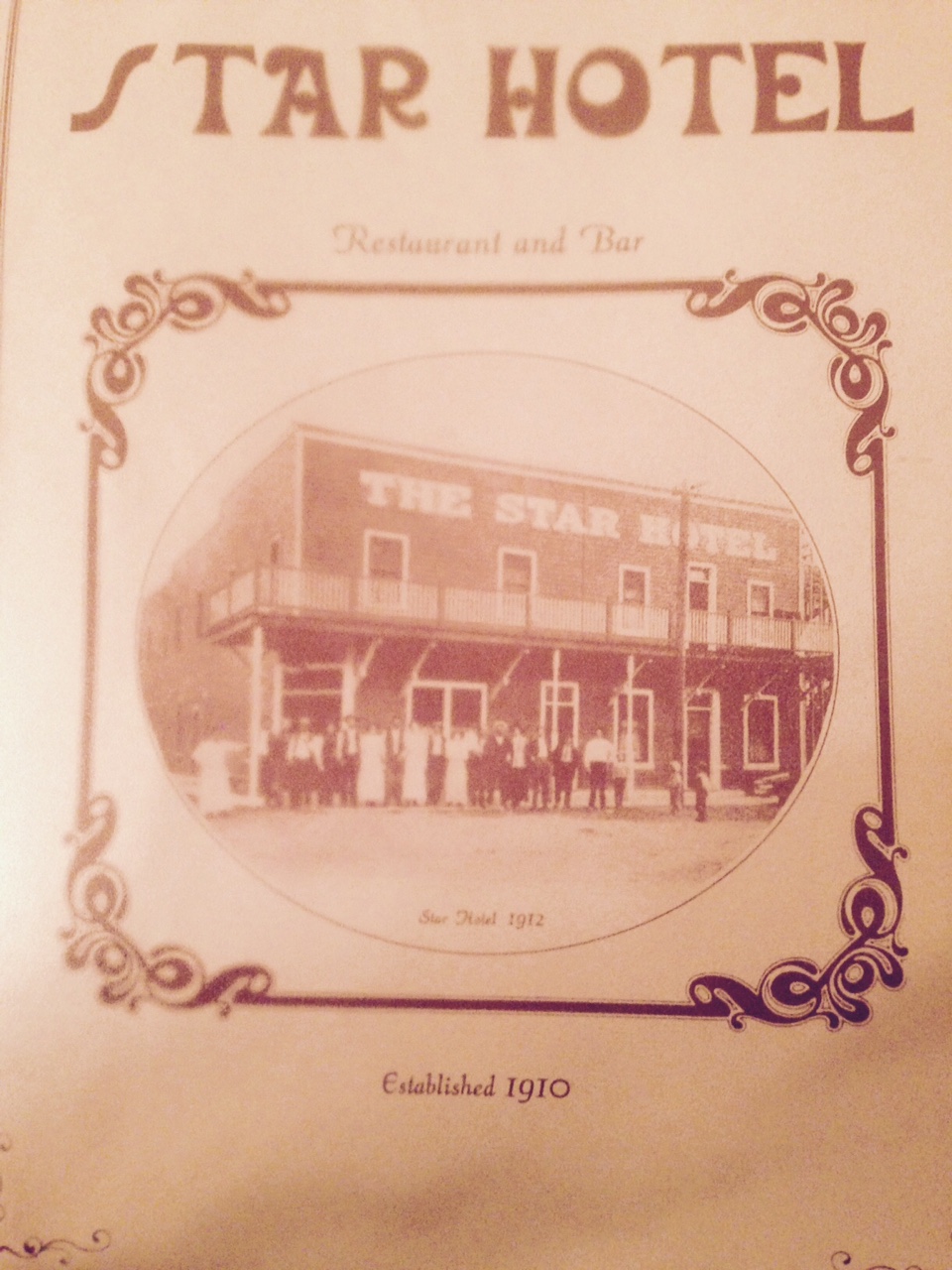
           The state's most famous Basque restaurant among Nevadans hides itself behind the usual chain of horrors that is road travel in America today. The Star Hotel was founded by and for Basques and their progeny who came to this part of the west as sheepherders in the early years of the 20th century. Family style, fresh vegetables wonderfully cooked, beef and chicken amidst mostly regulars who have found themselves fans of Basque culture through the stomach.                                                                 
For more on Basques in Nevada and Idaho, and other inter-mountain travels, see my book The Kingdom in the Country:

Saturday, August 29, 2015

Always wanted to live in a trailer

Now I have a lovely Spartan Manor with great neighbors except for the wild hogs that occasionally up-root the front yard                                                                                  
        High in the hills of east Napa, I have begun research for my new book about the valley. It's to be the third and final volume and will deal with, yes, cult cabernets and vinous glitz, but also with the first agricultural preserve in America, a real and quite special place hanging in the balance between nature and development.
        I work with a view of the southern Mayacamas mountains, in a kind of land-boat with vintage blonde panelling built in the '40s in far-off Tulsa, Oklahoma. 
       Do drop by: conawayjim@gmail.com                                       


(Next month: The Far Side of Eden Part III: Divide and Fall)
*


 To order my novel, Nose, click on:  
http://www.amazon.com/Nose-Novel-James-Conaway/dp/1250006848/ref=sr_1_1?s=books&ie=UTF8&qid=1362180145&sr=1-1&keywords=nose 

Sunday, August 23, 2015

The Far Side of Eden 14: Muir Redux

Note: I recently acquired the rights to my second Napa book, The Far Side of Eden. I think the struggle over the hillsides at the outset of this century covered in the book is relevant to the current discussion of development that includes new wineries and winery expansions, and I decided to run excerpts here. The series begins with the June postings in the drop-down menu to the right.                                                 


      Environmentalists in Sonoma were jealous of the resources available to environmentalists east of the Mayacamas. The Napans’ influence over the regional environment rankled the Sonomans, just as the high prices paid for Napa wine rankled Sonoma’s vintners. The Redwood chapter resented the funding available in Napa, and the fact that the Napa group would get even more attention.
      Carlene Mennen thought some members of the Sierra Club in Sonoma were too close to the industry. They had gotten the ear of the Sierra Club’s lawyers in San Francisco and were trying to kill the suit there. The whole question of so-called radical action was complicated by warring sentiments within the Sierra Club membership, some veterans demanding an end to logging in the national forests and others, including the club’s leaders, holding a more accommodating view of the use of public lands.
      This difference of opinion had resulted in a schism, the apostate group calling itself the John Muir Sierrans, which included the legendary David Brower, a mountain climber and veteran environmentalist. The leadership of the Sierra Club denounced the John Muir Sierrans as unruly and characterized their movement as an illegal “fire in a trash can” rather than a serious attempt to get back to the club’s roots.
      At the same time, the leadership was tightening control over individual cadres and strongly discouraging activities at odds with official policy. In the middle of all this the little Napa group arrived with a lawsuit and the money to pay for it, the target being a highly celebrated and influential industry that ordinary people did not associate with environmental degradation. The lawsuit could easily make the club sound radical, if not downright John Muir Sierran, the opponents of the suit argued. The battle, after all, was over a relatively insignificant, glitzy piece of real estate where, as some Sierra Clubbers said privately, “the resource is already lost.”
      The same people feared that actions like the Napa group’s could lessen support for the club, and for environmentalism in general, at a crucial moment when a presidential campaign was under way and there was a good chance of placing a true environmentalist, Al Gore, the current vice president, in the White House. Gore was being challenged by the Green Party candidate, Ralph Nader, and the Sierra Club grappled with a decision about which man to endorse. All this demanded caution and restraint.
      Carlene had not joined the Sierra Club until 1997. By then the Mennen Foundation had been in existence for a couple of years and she had had the opportunity to appraise several of the big environmental organizations. Some were good and some were death stars, absorbing contributions to pay big salaries and working against sound ecology and biological integrity. The Sierra Club was one of the good ones, she thought, but like all bureaucracies, it had to be watched.
      Sizable donations had put her on the club’s National Advisory Council, something those in the Redwood chapter didn’t know about. Money enabled her, sitting at the barn-gate table on Sylvaner Avenue, under the elkhorn chandelier, to pick up the telephone, immediately reach a lawyer in the Mission District headquarters, and have a meaningful conversation. She then telephoned Bill Yeates in Sacramento and asked him to make the same call.
                                                   *
      All summer Chris Malan videotaped activity on the Pahlmeyer Post-it. By the end of August the ground was bare and the last of the vines were going in, the heavy equipment shuttling back and forth, dust plumes rising. It was dry, dry as only the air can be when the wind blows from the desert.
According to existing regulations, all such work was supposed to stop by the first of September, but the work didn’t stop. Chris gave the workers a little more time and then, over Labor Day weekend, decided to act. She knew the ropes well enough by now to get a response without having to go through the county planning department, and she called the sheriff. He went up and shut the operation down until the following Tuesday, when it could be reviewed by the appropriate authorities, but by then the story was in the press.
      Jayson Pahlmeyer claimed to have obtained oral permission to continue working for a few days, until the grapes were finally planted, but the project stayed on hold. Most of the work was done, but once again his cowboys had run up hard against a deadline, prompting angry comparisons with the Viader vineyard (see The Far Side of Eden 1, at right) of the decade before and setting the stage for what was to come.
      Two weeks later, Tom Lippe drove up to Napa and walked into the courthouse, located between the county administrative building and the district attorney’s office. There he filed suit on behalf of the Sierra Club against Napa County for failing to enforce the California Environmental Quality Act, and he filed suit against the three individual defendants for putting in their vineyards.
      The fat was in the fire.
  (Starting next month: part III of The Far Side of Eden: Divide and Fall)       
                                                      *
   To order my memoir, go to: http://www.amazon.com/Memphis-Afternoons-James-Conaway/dp/0989725553/ref=sr_1_1?s=books&ie=UTF8&qid=1439940934&sr=1-1&keywords=memphis+afternoons