Friday, January 15, 2016

It's our pay dirt they're taking...

and leaving an unholy mess behind.                                                                  


                                                                                    Phool's gold?

The West has always meant opportunity. It fueled the fantasies and fortunes of millions, from the days when Kentucky was considered the West and the trans-mississippi wilderness had all the allure of a galactic outpost. Some saw opportunity in the grandeur of the West — an opportunity for the expansion of the American consciousness that Frederick Jackson Turner talked about. Others ignored natural beauty and spiritual growth or, more accurately, found beauty in the kingdom's ability to provide material value.
That version of the West is a larder where successive generations of the hungry and avaricious have rampaged, usually in collusion with government. And the West is still an awesome generator of product. Cash flow of both the BLM and Forest Service puts both agencies on a par with the biggest multinationals, in fact with whole nations. If they charged a competitive rate for grazing and lumber, and received royalties from mining operations, the figure would be much higher.
I wanted to understand the specifics behind this bonanza. Choosing among a multitude of money-making schemes was not easy. A uranium mine or a clear-cut slope, drilling rigs, a ski resort, or some master plan for a similar project hangs in every view of public lands, literal or figurative. The most remote, self-sufficient, innocent life can't escape the scars and enticements of development.
Gold mining is probably the most enduring symbol of opportunity in the West. Curiously, gold is also the most illusive. It riveted attention on the West in 1848 like nothing else had, not the expedition of Lewis and Clark, or the war with Mexico. The discovery of gold in California provided the factory-weary and the farm-bound the first glimpse of fast wealth. The speculative impulse so prevalent in development of the West might well have started at Sutter's Mill, on the American River. It flooded the Mormon and Gila trails, and the steamers taking prospectors south around the Horn or across the isthmus of Central America and up the coast — a hundred thousand, more or less. Newspaper editorialists inveighed against the abandonment of traditional values, and Thoreau declared the Gold Rush "the greatest disgrace on mankind."
Those who came west looking for gold weren't impressed with such moralizing. "The California they knew," wrote J. S. Holliday in The World Rushed In, "gave new meaning, even reality, to the most American of myths — the pursuit of happiness." Happiness ended up in a relatively small number of hands.
Then the rush moved to Nevada, to the Colorado Rockies, the banks of the Gila River, to southwest Canada, to Montana and Wyoming. Stories of great wealth carried weight, like that of Henry "Old Pancake" Comstock, who sold out for a mere eleven thousand dollars and didn't seem to care that his mine was worth a third of a billion. The big mining companies made most of the money, over the long haul, but it was the unlikely stories of gold that had the tightest grip on popular imagination: the sourdough miner washing several dollars' worth of gold from his beard; nuggets found lying in the dust in front of brothels.
The government owned the land by right of conquest, but miners didn't pay for what they jumped and rummaged through and left. Gold not only inspired some of the great excesses in the West, it also gave rise to laws that had the effect of depriving the rest of the citizens of the United States of payment for their treasure, and allowing miners and miners manque — of which there were and are still thousands — to live on public land so long as they kept it in a state of perpetual disruption.
An early effort to sell public mineral lands to pay off Civil War debts was subverted by a senator from Nevada named William Stewart. He had made a fortune in Virginia City gold and silver, and he later piggybacked his mining bill onto another that had passed the House, assuring that minerals found on the public domain were free. So was the use of the land. That and the subsequent Mining Law of 1872, which included hardrock mining, amounted to a radical departure from the usual disposal of the public lands, whereby some of the wealth is shared by the populace. That shameful law is still with us.

My pursuit not of gold but of gold miners took me north through the Arizona spring. I left the desert in the environs of Phoenix and crossed the marvelous high saddle of the Mazatzal Mountains, heading toward the Tonto National Forest. The conquistadors might have built their own Cibola in the Tonto Basin, or along the Mogollon Rim, a natural fortress and the bottom wrinkle in the belly of the Colorado Plateau. But first they would have had to beat off the Indians and master the techniques of hardrock mining. Placer gold, the sort that shows up in pans full of silt, was rare here. But below the rivers and streams lay deep seams of quartz and precious metals. The Coconino, Tonto, Gila, and Apache-Sitgreaves national forests all entertain latter-day prospectors after gold and silver. Part-time miners from the Rockies to the Pacific use the antiquated mining laws just to set up houses or hunting camps on government land.
In the town of Payson I found a Forest Service engineer responsible for inspecting claims on the Tonto. Gold miners were something of a problem, he said. "They take shots at one another on occasion. A few hardheads think we're violating their constitutional rights."
Few claims become patented mines. "Ninety percent of these guys think they have something, but they don't have the capability or the intent of developing it themselves. They just want to be bought out. Some sell a hole in the ground — an out-and-out scam."
All a miner has to do to stay on public land is conduct a hundred dollars' worth of "assessment" work. That usually means pushing some dirt around with a bulldozer. Twenty acres goes with a patented claim, and many such "mining" camps are sold on the open market, in direct violation of the law.
The mining operation I visited lay close to town, where FS land abutted the highway. A Lincoln Continental sat with the hood up, cables attached to the battery leading to a mobile home. At the edge of the clearing was an elaborate contraption where ore was pulverized; the tailings trailed down into a basin of caked yellow mud. Bits of machinery with no evident purpose lay in the shadow of a bulldozer of great vintage.
A piece of plywood next to the rutted entrance said "Shumway," not a mining procedure, but the name of the owner. He stood in the shade of a mesquite with another man, next to a pile of old electric motors. I heard Shumway tell his neighbor, as I approached, "If this one don't work, bring it back and take another one."
The neighbor went off with his purchase, grunting under its weight. Shumway tipped his cowboy hat low over his eyes and watched him go. "He's got a leaching mill," he said, as if we were old friends. "He's trying to get gold out of cinders. Volcanic rock. What'd you say your name was?"
Like so many users of public lands, Ray Shumway was perfectly willing to discuss his life with a stranger. He was a miner, he said, and the other man was a promoter. The mining fraternity was pretty evenly divided between the two, but interaction was constant and often critical. One man's mine could be part of another man's scheme.
Before I could digest that bit of lore, Shumway asked, "Want to see some gold?"
Out of the pocket of his jeans, which were burned full of holes, he took what looked like two golden Hershey Kisses and dropped them into my hand. They weighed about three ounces each and were worth about two thousand dollars. One had a reddish cast; the other shone with the brilliance of a new wedding band.
"People love to see gold," he said, taking his back. "You hand it to them, and they don't want to let go of it. I've seen people's hands start to shake, holding gold."
He was sixty but didn't look it, a big man with dark lashes covering blue eyes that could have come out of some cinematic version of the quest for El Dorado. He drew the toe of one boot through the dust, completing the image. He had dropped out of school when he was nine, he told me, up in Utah, and started digging uranium when he was thirteen, learning enough geology along the way to make it as a miner. "Vanadium and uranium travel together," he said, "generally in a sandstone formation."
That's where he had dug, earning enough money to buy a motorcycle and, later, several Piper 210's, in which he had buzzed his claims from Colorado to Nevada.
He showed me around. A retort oven, used to melt down concentrate from the mill, sat in the dust outside his cinderblock office. Inside, we stepped carefully among the electroplater for separating gold and silver from baser elements, containers for sulfuric acid (that explained the holes in his jeans), a machine for making distilled water, a scale in a glass case accurate to half a milligram, more cowboy boots, gruesome oil paintings of Apaches, and a girlie calendar. He did his own assaying amidst an almost incredible clutter of dust, rock, and containers of strange substances. If this is modern alchemy, I thought, no wonder gold is so expensive.
The falling of the price to about $350 an ounce had taken some of the gleam out of his operation. The mill was worth half a million dollars, he said, and that didn't include the earth movers, the dump trucks, the machinery, or the mine itself, located a few miles north on FS land. Shumway lived in the mobile home, where two cushionless aluminum chairs sat on boards in the blinding sun, with one of a succession of wives. Her name was Randy. I had seen the rustle of a curtain when I drove up, but that was all I would see.
"She's a city girl," he said. "She don't like the country, and she don't like mines. I think them holes scare her."
The mill was idle, he explained, because he needed at least thirty days' worth of ore guaranteed before he could crank up and hire a crew. So he and Randy spent a fair amount of time shopping down in Phoenix, waiting for the price of gold to go up. They ate out on Saturdays in Payson, and danced at a club with a big floor and a good Western swing band. Shumway liked dancing. He wanted to go public with his gold company and had filled out all the papers and hired a lawyer. Once it was done, he and Randy could move to Colorado.
We walked out to the mill. Here ore was pulverized in a drum and passed through a bowl with a centrifuge that separated the "heavies" — precious metals — from the "lights," the dross. The former went into a chemical froth called a float, which bonded air bubbles with bits of gold and silver and brought these heavies to the surface. The product was high-grade "con" — concentrate of sufficient density to justify feeding it into a smelter from which emerged the gold Hershey Kisses, or bars stamped .999 ad infinitum, the official designation of ultimate value.
"Gold ain't worth anything," Shumway said. ''Just what value people put on it. Gold brings out the greed."
His life seemed crowded with enemies. While he and Randy were in Phoenix, a friend stole thirty-five ounces of heavies out of the bowl and Shumway's front-end loader. The thief took his haul clear to Kansas before the police stopped him. That was inconsequential compared to Shumway's problems with other miners. Some neighbors tried to jump his claims, he said, and to shut him down. He found his bulldozer tipped over one morning, and dirt in every gas tank on the place. There had been confrontations at the mine shaft, and two lawsuits.
"That's greed," Shumway said.
He figured he had spent twenty-seven thousand dollars on this particular feud, and that didn't include equipment and attorneys. "I was new to Arizona, I wanted to get along with everybody. I told the lawyer it would be cheaper for me to run these fellas off with a gun. He said I'd better not do that, then charged me a hundred dollars for the advice."
I asked why he had given up uranium for the chancier prospect of gold.
"I came down to drill for uranium, and some boys here showed me the gold. These little mines have a fine grade, too fine for the tables" — vibrating slabs that had been used for years to separate lights and heavies. Also, he liked the climate.
That was seven years ago. He had filed a claim and a mining plan with the FS. The site containing Shumway's mill, mobile home, office, and menagerie of machinery did not belong to him, but to the federal government. He had to pay a five-dollar filing fee and put up a bond assuring that he would restore the land if he pulled out, and that was it. He paid no taxes on the thirty acres he occupied, and no royal ties on what he mined. Such were the anomalies that kept small miners afloat, and had made big ones wealthy on public resources. Once the site was patented and its commercial viability proved, then Shumway could buy the land at a nominal fee.
"The Forest Service might try to keep me from patenting," he said. "Depends on the man handling the application," another potential enemy. "The Forest thinks the land belongs to it, but it don't. It belongs to everybody."
He invited me into the trailer. The bleak exterior had not prepared me for the clean carpets, upholstered chairs, a coffee table supporting a book of Andrew Wyeth's paintings, a neat kitchenette with wine glasses lined up on the pass-through, a collection of butterflies in a glass case. Shumway was clearly a man of two parts, and he kept one of them carefully hidden in Payson.
He took off his hat and ran a hand through gray hair. "I'll probably get back into uranium, after we go public. I'll build a fence here, and hire somebody to run the place."
"What'll you do if the public offering doesn't work out?"
"A miner can always make money." He nudged a coffee table leg with a toe. "You can always dig some ore and sort the big chunks, mash it, and pan a line. You have to know what you're doing, but you can make a living."
I could hear Randy moving around at the far end of the trailer. The telephone rang. Shumway was expecting a call from his lawyer — another hundred dollars.
"Mining's fun," he was saying. "You never know what's behind the next rock outcrop. One day you're poor, and the next day you're rich. That's the thing about mining."
                                                             From:            

Wednesday, January 13, 2016

Abusing public land is an institution in the West


                                                                  God’s Remnants

The BLM administers 178 million acres in the Lower Forty-eight and about 100 million acres in Alaska. It employs about ten thousand people and maintains fifty offices in the American West. Twenty-seven thousand work for the Forest Service, which is less endowed with land. The FS oversees a mere 23 million acres in Alaska and 146 million acres in the West, as well as a much smaller domain east of the Rockies.
Every day both agencies try to manage natural calamities the size of small wars, involving a thousand years of history. One of the things I wanted to see while traveling through our public lands was how government agents fit into a landscape rife with tradition, management objectives, and the contending needs and fantasies of users. I imagined myself for a time in the green trousers and khaki shirt symbolizing the FS, or assigned to a beige-colored BLM pickup with a decal on the door and a view of limitless country, and limitless regulations.
The BLM's land in the West includes 25 million acres of sufficient beauty and remoteness to be officially designated wilderness. In addition, there are 70 million acres of wetlands. About 20 percent of America's big game animals roam BLM land. Visitor days, the measurement of use of BLM land by recreationists, exceed 200 million a year. It is as if every American spent a day in one of the remote parts of the continent.
The National Register of Historic Places contains ninety archaeological and paleontological sites on BLM land. Before 1976, when Congress passed the Federal Land Policy and Management Act, the BLM had only to dispose of public lands; now it really has to manage and care for them under the rubric of "multiple use." That means a backpacker, a amateur geologist, or a fossil collector has as valid a claim on the land as a lumberman or a uranium miner. What had for decades been known jocularly as the Bureau of Livestock and Mining was forced to hire biologists, archaeologists, and other professionals to comply with the demand for broad and exacting inventories.

Anasazi is a Navajo word meaning the "ancient ones" or "ancient enemies" who lived in the Southwest before the Navajo. They were hunter-gatherers whose culture went back ten thousand or eleven thousand years. The Anasazi farmed in the shadow of red cliffs and created a dense social fabric over much of the Colorado Plateau. They dropped out of sight sometime in the fifteenth century, victims of war or drought or some unaccounted-for demographic upheaval, and left behind a wealth of artifacts.
The early Anasazi were known as Basketmakers, an apparently random term bestowed by Richard Wetherill, a pot hunter of renown, who in the 1890s amassed a collection of Anasazi artifacts and sent them to the American Museum of Natural History in New York. I had gone to see them one bleak January afternoon, before coming out West. The collection had not been displayed in years and was locked away beneath the streets of Manhattan. A young archaeologist took me down into the basement and struck a match in a cavernous room to find the light switch.
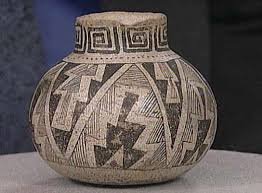
Tall metal cabinets leaped out of the shadows, full of bowls in smooth reds and grays, carved wooden spoons, and bundled mats too splendid to be buried. There were dried seeds of rice grass, pumpkin, squash, and pinon nuts; dice made from reeds; bone scrapers; clubs; chert bird points; a clay effigy of a dove. The tiny corncobs were Mesoamerican precursors of hybrids on Iowa farms. There were trays of gourd vessels, hafted ax blades, turquoise and shells strung on cords, evidence that these ancients traded with others who had reached the sea.
All these things came from what is now public lands. The West brims with Anasazi sites; locating and protecting them is an important part of the mandate of the Bureau of Land Management and the Forest Service, and not always a safe one. An Anasazi bowl in good condition then fetched five thousand dollars, a basket, ten thousand. The goods move through the same marketing chain as other contraband, notably drugs, and share some of the same clientele.
I read a story in a Western magazine about pot hunters in San Juan County, Utah, who reportedly laid down a line of cocaine on the 'dozer blade and inhaled it before falling on an Anasazi burial site in a collecting frenzy. There were stories of thieves cutting pictographs out of rock with chain saws and loading them into choppers for collectors as far away as Germany and Japan. I decided to start my investigation on the Arizona Strip, the northwest part of Arizona between the Utah border and the Colorado River — a high, lost piece of the West cut off from southern access by the millennial crack of the Grand Canyon.
There the closest Interstate arches up from Las Vegas toward Salt Lake City, brushing the western corner and avoiding the canyons and other natural disasters as rich in history as in geology. Plateaus named for Indian tribes — Shivwits, Uinkaret, Kanab, Kaibab, Paria — march off to the east, principal players in the grander production of the Colorado Plateau itself, eroded out of a continent's worth of rock. The broad valleys are silver-green with sagebrush, beneath high forested tablelands of confusing, often frightening aspect.
There are no cities and only two blacktop roads on the Strip, a few satellite Mormon communities, and 3 million acres belonging to the BLM and the Forest Service. Some of the country is so arid that 1oo acres is needed to feed one cow for six months. It also supports black-tailed jack rabbits, desert bighorns, mountain lions, the Great Basin spade-foot toad, assorted lizards and rats, gila monsters, the desert tortoise, and an unusually large version of the mule deer.
The Strip is administered from St. George, just over the Utah line. There I went looking among the partitions of the BLM office for the chief archaeologist. Like most of his colleagues, he wore cowboy boots, a yoked shirt, and turquoise bracelets. His name was Rick Malcomson, and he wasn't a typical scholar, having spent twenty-three years in military intelligence. After retirement from the military he had stuffed himself with anthropological coursework and landed a job with the BLM.
Malcomson sounded more like a cop than a dryland Indiana Jones. Most of his friends worked in the sheriff’s department, he said. All were members of the Elks, as was Malcomson. Mormons didn't officially recognize the presence of humans on the North American continent prior to about 400 B.C., so being an archaeologist was a bit awkward socially.
He exchanged ordinary spectacles for tinted ones, retrieved his Thermos of coffee, and led me out to the BLM Suburban that was to take us down along the Virgin River. On the way we passed a deputy sheriff in a big white sedan, and Malcomson waved. "There goes the Superior Past Exalted Ruler of the Elks," he said.
I wanted to talk about the Anasazi, but Malcomson talked about the Church of Jesus Christ of Latter-Day Saints — the Mormons. He divided them into two groups: those who tolerated his smoking, drinking, and opinions, and "the bigots." The latter sent their faithful around to his house, to try to convert him; they had turned his only friend in the neighborhood against him.
"He hasn't spoken to me in four years," Malcomson said, taking a cigarette from a metal case. "He used to come over on Saturday mornings for coffee. He'd smoke his pipe, and I'd smoke my cigar, and we'd talk. Then his wife turned Mormon. Well, the coffee went first. Then the pipe, then the conversation…. The Mormons have something for you to do twenty-four hours a day. I've taught Soviet intelligence for the Defense Department, and if I didn't know better I'd say Joseph Smith got the LDS system from them. Or maybe the Soviets got theirs from the Mormons."
We passed through the Virgin gorge, high rocky terraces where bighorns sometimes show themselves. Tamarisk bloomed along the river. The country around us was all owned by the BLM, as was most of the broad benches where the Colorado Plateau swept down to the desert. We took an abandoned road off the Interstate and stopped in the dust close to the Nevada state line.
"Watch out," he said, "for buzz-tail."
He meant rattlesnakes. We trudged out onto a point a hundred feet above the river. Potsherds and bits of flaked stone, some transparent, littered the sand. They reminded me of dirty snow piled in Central Park. "Vandals," Malcomson said, puffing away at his Lark in the heat. "It makes me so damn mad." A cottontail cowered in a pot hunter's fresh spade mark, then bolted. "People carry shovels around in their pickups, and wire for sifting what they dig."
Malcomson wasn't interested in acquiring evidence here. The site had already been officially excavated and catalogued and the information entombed in some university. These pot hunters were just recreationists on a Sunday outing.
Malcomson saw himself beleaguered by artifact enthusiasts. "Formerly the BLM district managers in St. George have been either latent pot hunters or treasure hunters. One called me into his office and said he had just bought a metal detector. 'Can I take it on public land?' he asked. 'If I get a buzz, can I go for it?' I said, 'You can get a buzz, but you can't go for it.' He said I'd have to take him to court to enforce that one."
Sticking a shovel into a recorded archaeological site on public land, said Malcomson, violated the law under the Archaeological Resources Protection Act (ARPA). Probably 90 percent of Anasazi artifacts displayed in museums and private exhibits came from public land — mostly BLM. A few piddling arrests had been made. On the Arizona Strip, a BLM enforcement ranger working out of Vegas had arrested a man for pot-hunting, and found that the man's house was full of dynamite. "Posse Comitatus," Malcomson said. "If that agent had moved wrong when he was examining that stuff, he wouldn't be around today."
The BLM considered ARPA to be a prime headache. “I’m always being asked to violate professional standards. Somebody in the agency will come to me and say they want to dig a water catchment system for one of the fair-haired permittees. I tell them it'll take about a month and a half to excavate the site properly, and about nine thousand dollars for carbon dating, ceramic analysis, and publication. They say, 'Oh, no, just do the digging. We'll get the money later for the rest.' "
On the way back to St. George he showed me a golf course built on Anasazi grave sites. When the builders had excavated for the foundation for the clubhouse, they had uncovered pots and other artifacts. "The discovery was announced over the radio," Malcomson said, "and half the town came out to collect pots."
Petroglyphs had been chipped into the rock faces above the fairways; they were too big to steal and too difficult to climb up and deface. Passers-by had a view of strange, serpentine squiggles that have yet to be deciphered. The golfers I saw didn't seem interested in this Anasazi conundrum.
We parked and walked up a little draw where the development ended and public land began. Here the rocks bearing petroglyphs were more accessible; a truck had backed in recently to cart off a few for patio embellishment. Neighborhood children had turned a shallow cave into a clubhouse. The eye of a petroglyph gazed down from one wall, at a copy of Penthouse on an overturned fruit crate.
Malcomson flipped through the magazine, clucking at faded color photographs of naked girls. "Good Mormon kids," he said.
                                                                                     From:         

Monday, January 11, 2016

It's not all in eastern Oregon

Meanwhile, within a few miles of the Department of Homeland Security, is another large (very) part of the vigilante problem:                                                                     
(The Nation's Gun Show at the Dulles Expo Center in Virginia. Photo by Jo Tartt, from his American Gothic project.) 
                Read about the fastest gun in the West: http://cjonwine.blogspot.com/2014/04/the-fastest-gun-in-west.html                                                    

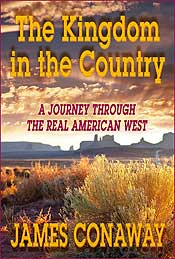
Read it all at: http://www.amazon.com/The-Kingdom-Country-Journey-American/dp/098972557X/ref=as_sl_pc_tf_til?tag=fearlessbooks-20&linkCode=w00&linkId=&creativeASIN=098972557X
                                                    *
For a broader look at the public lands confiscation movement in the west read this from the NY Times:
http://www.nytimes.com/2016/01/11/us/the-larger-but-quieter-than-bundy-push-to-take-over-federal-land.html?rref=collection%2Fsectioncollection%2Fus&action=click&contentCollection=us&region=rank&module=package&version=highlights&contentPlacement=1&pgtype=sectionfront

Saturday, January 9, 2016

You can lead a cowboy hat to history, but...

Why is there no Homeland Security in eastern Oregon? Because the feds are buffaloed. They should promptly restore peace and productivity to the Malheur Wildlife Refuge, and start teaching American history 101 to occupiers - in jail.                                                     

The following's an abridged account of the ownership of western lands from The Kingdom in the Country. The setting's New Mexico but could be most anywhere in the intermountain West:                                                                       


      I went to bed in their spare room and propped the pillows up against the whitewashed wall. Stuffed animals sat in old milk crates, waiting for the owners' grandchildren. Beyond the window I could see hills flushed with the yellow light of a westward-trending moon and the dark crease of the draw which ran through the ranch, dry now. I thought of the Anglos who settled here in the early nineteenth century; they had contended with the Spanish for what they considered theirs. In 1845 a magazine editor named John L. Sullivan excoriated foreign countries for "limiting our greatness and checking the fulfillment of our manifest destiny to overspread the continent allotted by Providence for the free development of our yearly multiplying millions."
Those multiplying millions were at first reluctant to die at the hands of savages, or to starve in country rough beyond their imagining; they had to be oratorically prodded out of Eastern cities. By the time of the Civil War most land in the West not too rough or dry to be plowed had come into private ownership, much of it through fraud. The Homestead Act at the end of a string of uncommonly wet years moved nesters into places normally unfit for farming or other human sustenance. Boosters like William Gilpin, the territorial governor of Colorado, proclaimed that moisture followed the plow and that firewood lay under the sand and that, in short, agrarian culture could modify the West's aridity and transform the landscape. It was a cruelly deceptive claim.
Tenacious dirt plowers and their suppliers, including disgruntled Southerners fleeing the aftermath of the Civil War, settled by the dozens along the Macho, where no families live today. Three derelict schoolhouses are testimony to the homesteaders' optimism. Eighteen inches of annual rain at the end of the last century had meant flowing streams year round, and flourishing grain; but that precipitation proved to be a fluke, and widespread disaster followed in the drier years. The owner of this house had himself been raised in one of the settlers' dugouts, a one-room house with a dirt floor, but he belonged to a very different tradition, that of the stockman, fencer of the range. His stepfather had bought up a number of homesteads early in the century, after extended drought ended the squatters' dreams.
John Wesley Powell, the first runner of the Colorado River and visionary of the settled arid West, advocated more land for homesteaders, to be sold or given to them according to the amount of available water. Where water was scarce, more land would help overcome the shortage of moisture and so of crops. But Congress stuck with its policy; too little land for homesteads created cemeteries in country where individual families could not make a living on a quarter-section or a half-section or even a whole section. Before the end of the century, cattle and sheep had come to dominate the West.
In 1890 the U.S. Bureau of the Census announced that for the first time it had been unable to discover a clear boundary between wild and settled areas. Officially, there was no longer a frontier. But the West as a state of mind remained important to Americans, whether or not they intended to go there. "American social development has been continually beginning over again on the frontier," Frederick Jackson Turner said in 1893, in a speech before the American Historical Association that left a lasting impression. Free land, he said, had made our unique democracy possible. "This perennial rebirth, this fluidity of American life, this expansion westward with its new opportunities . . furnish the forces dominating American character."
The evolution of public lands could be seen from the window of this spare room. The homesteads had clung to the river, where low meadows received water at least some of the year. They could be plowed, and wells dug, and a house built like this one, within sight if not the shade of cottonwoods. The higher country, away from water — the land nobody wanted — touched and mingled with the private holdings, but its ownership had been ignored or taken for granted.
No one wanted to buy this land when it was for sale. It had been free for the use up until the passage of the Taylor Grazing Act. Now the government leased it for far less than the cost of grazing rights on similar private land, but ranchers had always considered the public land theirs.
They still do.                                                                         
To order go to: http://www.amazon.com/The-Kingdom-Country-Journey-American/dp/098972557X/ref=as_sl_pc_tf_til?tag=fearlessbooks-20&linkCode=w00&linkId=&creativeASIN=098972557X

Thursday, January 7, 2016

The difference between men and hats (and hoodies)

Lots of response to posts about the occupation of the Malheur National Wildlife Refuge in eastern Oregon. The occupiers spend time watching Fox News as they wage ideological war against "the government," reason, and birds.


To read about real cowboys go to:
http://cjonwine.blogspot.com/2014/05/lighting-out-for-territories-6-latino.htm
                                                                                

Wednesday, January 6, 2016

Every cowboy hat should try to read this

The ruckus in eastern Oregon arises from ignorance and greed, not history. Ranchers and others have enjoyed the privilege of using everyone's land since the Louisiana Purchase. Here's the introduction to my book about public lands in the West, written soon after I fled the Washington Post:  


Vamos . . .
I first heard about the West — the West as experience — from my grandmother. In 1900, when she was thirteen, she traveled from Arkansas to California in a covered wagon. Her mother had tuberculosis, and the doctor had prescribed a slow transition from humidity to drier climes. At night the girl slept under the wagon, and during the day she shot jack rabbits from the hard plank seat. Her father had taught her to use a rifle and once convinced her to shoot a cigar out of his mouth in an audacious display of marksmanship, or so she claimed.
My parents took the same route, to Tucson, in the early thirties, from Memphis, their Chevy convertible packed with everything they owned. They had just married and were avoiding hometown rules and expectations. The West was dry and distant, and imbued with exotic promise. They rented a stone house in the Sonoran Desert, and for a season my father chased cows for a rancher while my mother filled up canvas with paintings of ocotillo and red rock. They returned home two years later, to the prospect of children, a world war, and endless responsibility. But the photographs of them in the West show an unencumbered man and woman, touched with radiance, standing amidst the spectacular geologic rubble of high, arid ranges.
My father's spurs became the legacy of a man interested in escape, not horses. They hung on our wall in Memphis as life went on, the big Mexican rowels rusting, the hand-tooled leather going to dust. Memphis in the fifties claimed to have more churches than gas stations, and I grew up yearning for a glimpse of all that land beyond the Mississippi, and the freedom it implied. Memphis had served as a jumping-off point for westward migration a hundred years before, as important in its way as St. Louis. Travelers who were not "GTT" — Gone to Texas — angled up through Fort Smith, Arkansas, and then headed southwestward to their real or imagined destinies. Walter Prescott Webb compared the South and the West in The Great Plains. Both, he said, were exploited by the more powerful Northeast, both "tributary to the masters of the Industrial Revolution. Both kingdoms produced what promised to be a distinctive civilization, a thing apart in American life."
I finally got that glimpse of the West while in college. I worked one summer as a hotel desk clerk in Central City, Colorado, and another summer harvesting peas in Washington State. I rode the Greyhound across miles of apparent emptiness between home and what amounted to another country. I often told myself that someday I would really get to know the West.
In the early 1980s I lived in Washington, D.C., about as far from those open spaces as I could get and still be in the republic. I worked for the Washington Post, writing profiles of various characters who washed up on the shores of Ronald Reagan's Potomac. They were an intriguing lot — the White House chief of staff, the director of Central Intelligence, the secretary of defense, the ambassador to the United Nations — all housed in buildings much like the Post's , with security guards and windows that didn't open. I also performed, for the Style section, what were referred to as "day hits" — shorter pieces about prominent visitors as various as the Dalai Lama and a rising actress who had tied up Jerry Lewis in a film about urban obsessions.
One day, at the office of the secretary of the interior, in a gray edifice seemingly built to confirm every prejudice about federal architecture, I met James Watt, the secretary of the interior. Watt viewed the American West as an economic opportunity and an ideological battleground. His contentiousness and political zeal made him popular among developers and unpopular with conservationists. He had become the most controversial of all the interior secretaries, including Harold Ickes, who had used his friendship with Franklin Roosevelt to transform the department into a real power base. Ickes had a bedroom at Interior because he spent so much time there. He reportedly used it for his liaisons as well as for sleeping. He suffered a heart attack in 1937 and insisted upon recuperating there. Watt had the bedroom transformed into his executive suite, and used the expansive westward-facing office — the most impressive in town — only for ceremony.
I eventually found myself sitting with Watt in his limousine, in the basement of lnterior, while the secretary denounced environmentalists and the Eastern press as tacit conspirators in an attempt to overthrow the democracy. He seemed oddly vulnerable, with his Coke-bottle glasses, high domed forehead, and ideological fervor. "The battle's not over the environment," he said. "They want to change our form of government."
It was a preposterous view, but unequivocally held and unequivocally stated — a rarity in Washington. Watt was dismantling Interior's influence, and some of its prime country as well, in the name of God and progress. But the controversy wasn't what interested me. I couldn't forget the epiphany I had experienced when I first walked into Secretary Watt's outer office, or the sense of possibility it entailed. In the deep russet carpet, the wood paneling, and the portraits of former secretaries lay the intimation of distant peaks, desert rock, and riverine lands. Congress and the Supreme Court had the law, the Pentagon had the power of destruction, but Interior had real estate — millions of prime acres in the West.
Later, I spread a map of America's public lands on my living room floor. Great gold-colored swaths represented Interior's land, most of it the responsibility of the Bureau of Land Management; green represented land administered by the U.S. Forest Service, the sister agency within the Department of Agriculture. Green and gold overlay much of the states between the Rockies and the Pacific — a federal domain of staggering immensity.
The two agencies — the Bureau of Land Management and the Forest Service — can be seen as a monolith. Both grew out of the old General Land Office, which was set up to deal with the remnants of western expansion. The BLM and the Forest Service control close to half of the intermountain West, a domain almost as large as western Europe, but relatively unpopulated. Surveying my map, it occurred to me that a person could travel this federal kingdom from the Mexican border to Canada and seldom leave it, and never lose sight of it. 
Over the months I returned on my own behalf to the gray buildings of lnterior and Agriculture to talk to BLM and Forest Service career officers and resource specialists. Many of them seemed out of place in Washington with their wide ties and sideburns, talking in accents from the far side of the Mississippi, and trying to manage more than 300 million acres in the Lower Forty-eight. Their kingdom, spread with some of the most beautiful and terrifying terrain on Earth, seems endless; but for many people it has little meaning. To most Easterners, for instance, public lands are parks — which actually represent just a tiny fraction of the whole — or worthless pieces of desolation left over from an age of scalps flapping on lodge poles.
Meanwhile, like a lot of other males in their forties, I was developing physical abilities beyond those required for a merely urban existence. Weightlifting was an unacknowledged preparation for a fantasy beginning to take shape. I ran daily in Rock Creek Park, a fugitive in shoes designed for the briefly unencumbered, and reflective garb more appropriate on an astronaut. The park cuts through the city like a verdant wedge and offers in its approximation of wildness one of the boons of Washington life. On otherwise deserted trails, far from quarrelsome traffic, I could envision bigger country where less rain fell; in miniature chasms I saw the origins of a grander, broader landscape.
I began to collect maps as a lifer collects law manuals. They provided detail about the national forests in the West and about remote areas run by the BLM, forlorn and therefore alluring, where roads and towns are pathetically overwhelmed by the country.
I decided to head west, without a salary or the need for day hits, and took a year's leave of absence from Style, knowing I wouldn't return. I told myself that I was obeying the same impulse that had drawn people out of fields and factories a century before; I had to admit that an adolescent urge had become a middle-aged preoccupation. Giving way to it was chancy and painful but irresistible. I said goodbye to my wife and children, knowing I wouldn't see them for months, and left in a van packed to the windowsills with camping gear, books, a typewriter, and oil company credit cards.
Every day travelers in station wagons and five-axle semis look out their windows at the West and think that all that alternately inspiring and godawful stuff belongs to the descendant of some titled lord or to some son of a bitch too tough or too dumb to up and leave. Most of us travel it for days without knowing that it belongs to us. People living there lease parts of the West and turn their animals or their clients loose on it. They dig holes in it, dynamite it, mine it, cut timber from it, steal parts of it to build their patios, grow dope on it, hunt on it, drive machines of fantastic aspect across it, get drunk on it, make love and sleep on it.


I left Washington to look at federal real estate. What I discovered was people — repositories of a national myth. Cowboys, Indians, gold miners, mountain men, and hustlers you might expect; but I also found some I couldn't have foreseen: a gunfighter holding sway over a remote part of Wyoming at the end of the twentieth century, for instance, and men still taking multiple wives in the shadow of flaming sandstone cliffs. I found defenders of a mythic place, abusers of the same, some ordinary and many extraordinary men and women. Where they fit in the larger scheme did not become clear to me until much later, after the bits of experience had been scattered. In the pages that follow, these people appear, not according to my itinerary, but in deference to their purposes in the land that supposedly belongs to no one.
                                                      *
      For a succinct summary of the unforeseen consequences of Manifest Destiny, read today's piece in the New York Times: http://www.nytimes.com/2016/01/06/upshot/why-the-government-owns-so-much-land-in-the-west.html?rref=collection%2Fsectioncollection%2Fus&action=click&contentCollection=us&region=rank&module=package&version=highlights&contentPlacement=6&pgtype=sectionfront&_r=0
     To read more excerpts from Kingdom go to the drop-down menu, right, and start with April, 2014:
                                                                             

Monday, January 4, 2016

Idiots occupy a wildlife refuge

... to protest the fact that public lands belong to all Americans, not just to them.


     The stand-off that wasn't in eastern Oregon reminds us that terrorism is in the eye of the beholder. If environmentalists had done this to highlight, say, lack of protection for wolves in the northern plains, they would be compared to jihadists. But if beef producers and assorted Tea Party malcontents do it they're... well, what exactly are they since the land isn't theirs, nor are the responsibilities of administering it?
     For more on this issue go to The Kingdom in the Country, my travelogue about public lands in the inter-mountain west, with excerpts starting in April 2014, at right in the drop-down menu.
     And don't miss Edward Abbey, who was passionate about this subject: http://cjonwine.blogspot.com/2014/01/edward-abbey-rip.html
                             (Next: Don Corleone's Desk: 2)
                                                       *


To order The Kingdom in the Country from Amazon,  go to:
http://www.amazon.com/The-Kingdom-Country-Journey-American/dp/098972557X/ref=as_sl_pc_tf_til?tag=fearlessbooks-20&linkCode=w00&linkId=&creativeASIN=098972557X

Wednesday, December 30, 2015

Don Corleone's desk: 1

My second book about the valley, The Far Side of Eden, was published in 2002. What follows is a series taken from it that helps explain some of the issues and personalities that still bear heavily on the present. Earlier postings can be found in the menu to the right, starting in June 2015. 
                                                                             
      A bulldozer operator cutting a foundation for a mansion overlooking the valley floor or clearing chaparral for a vineyard still came across the odd redwood stake, hammered into the earth in another era. And if the driver knew the valley, he might say, “Ah, the Italians.”
      Their names are mostly forgotten, as are the men and women who put minds and backs into what became a triumph of transplantation. They were once as exotic as the Chinese coolies they replaced in the fields, identified by hard cheese, stubby smoldering toscanos, and unpronounceable names. The Italians took up the tough tasks and seemed to enjoy them, their warm, explosive speech echoing through the vineyards and their smiles in the old photographs full of teeth. They paid homage to grapes few people had heard of and no one dreamed would someday have a devoted following here as “Cal-Italos” and “super-Tuscans.” The names suggested foreign potentates, saints, and weather—barbera, sangiovese, nebbiolo. They drank local “zin” (zinfandel) and “pets” (petite sirah) with gusto, in great quantities.
     Their cooking varied beyond the imaginings of the Californians—how could there be so many different kinds of noodles? And they were loyal. Take on one Italian, take on all. Unfazed by the stupendous effort required to plant and tend grapes by hand, they had unbounded confidence in other endeavors, insisting on their due, maintaining bella figura, gradually buying up plots in the Central Valley and in the narrow coastal defiles, farming land no one else wanted, including the hillsides. The already wealthy owners of those Victorian piles built in the late nineteenth century in Napa and Sonoma couldn’t outlast the paisans, whose favorite game involved bowling without pins and who pursued life on a level of emotional intensity exhausting to the uninitiated.
     There was nothing that could not be contended. “An argument,” as one descendant recognized, “is an Italian conversation.”
     Mostly they worked. It was as if the Protestant ethic had been grafted onto the Catholic mysteries. The outcome of all this energy was not limited to wine, food, and opera. There were Italians in the bank in San Francisco, and so a large segment of the wine industry was nurtured. Italian fortunes came to be exemplified by two names famous in the California vineyard, Gallo and Mondavi. Ernest Gallo showed California how to sell wine with a single-minded competitiveness that left the competition dry-mouthed. Eventually he turned bottles with handles on them into sleek Bordelais shapes containing French varietals and sold them at prices no one ever thought Gallo wines would aspire to. But more than anyone in Napa Valley, it was Robert Mondavi who boosted the appreciation of fine California wine.
     The Mondavis had been preceded in the valley by Louis Martini, an imposing figure in a black cloak, a gifted winemaker but proud, terminally argumentative, thoroughly Italian. Had Martini possessed a talent for public relations, there would never have been the Robert Mondavi phenomenon. Robert and his brother, Peter, began in Sunny St. Helena Winery with their father’s money, Robert dreaming of oak barrels and a product to compete with the best, which then meant French. But his and Peter’s arrangement—an echo of the Gallo brothers’ anthem, “I’ll sell all the wine you can make if you’ll make all the wine I can sell”—faltered after too many Italian conversations, and Robert went out on his own.
     So relentless was his selling and so great was his success that he attracted a Frenchman—the Baron Rothschild—to Napa Valley in the 1970s, a coup and a watershed. But now, at the end of the twentieth century, the Robert Mondavi Winery was a publicly held corporation where Italian conversations abounded between Robert’s two sons, the lucky spermers Michael and Tim, with their sister a distant moderating force. What would happen to the corporation when the old man died was anybody’s guess.
     The most famous Italian in the valley might still be Robert, but increasingly attention focused on another name, one with fame related not to wine but to the spinning of celluloid fantasy and, increasingly, to tourism.

     “Don Corleone’s desk will be in the entrance hall,” said the handsome young woman serving as a tour guide, talking about the desk used in the film The Godfather. “It’s a statement, you know, of Francis’s accomplishments.”

                                             (Continued)
                                                      *                                             


 To order Napa:

Thursday, December 24, 2015

The revelatory power of a row of trees

My second book about the valley, The Far Side of Eden, was published in 2002. What follows is a series taken from it that helps explain some of the issues and personalities that still bear heavily on the present. Earlier postings can be found in the menu to the right, starting in June 2015. 


  One day Roland Wentzel saw a bearded man in glasses and blue jeans drive up in a car and get out. He was smiling, as Wentzel remembered it. “He said, ‘Hi, I’m your new neighbor.’ Then he told me how rich he was and that he was going to sue me.”


     Bob Bressler would dispute that account. “I didn’t get in my car and drive over there,” he said. ”I was coming home from somewhere and saw him, and simply stopped.” He would deny threatening to sue because ”that would have been illogical.”

     A subsequent survey proved that the Bresslers did indeed own the allée. They granted the Wentzels an easement to use it anyway, and decided to cut down one row of trees, acting on the advice of Dave Abreu, the vineyard manager, whose sole interest was vines. The Bresslers had learned that grapes, not trees, were what Napa Valley was all about, that if you wanted to be taken seriously, you had to be willing to go to the mat over quality cabernet sauvignon. The trees not only took up space but would also shade the young vines, and they were, as Bressler pointed out, “only poplars, for God’s sake.”
     The truth was that neither Bressler nor Wentzel stood to lose anything substantial. Failure to produce a sought-after, expensive wine would not appreciably affect Bressler’s fortune, nor was Wentzel financially prohibited from tearing down his little guesthouse and building a petite allée on his own property. And whoever failed to get what he wanted could well afford to move somewhere else and start over again.
      What really transpired was a contest of wills among people accustomed to getting what they wanted: vineyard owner, vineyard manager, and neighbor were all convinced of the rightness of their position and unwilling to compromise. The argument was not about grapevines, profit, peri-urban aesthetics, or the need for yet another cult cabernet, but about the importance of winning, and a direct reflection of corporate values projected on a small, increasingly fragile part of America.
     Some perspective on this was provided by Samson Bowers, a tall, courtly, aging St. Helena city councilman—white goatee, white buzzcut, tennis shorts—who lived for a time in the Wentzels’ guest cottage, liked the poplars, and after learning that the Bresslers intended to remove one row of them, decided to help out. Not officially but artistically, by making a scale drawing of the petite allée and plotting the angle of afternoon sun and proving that cutting the trees would do away with only about eight feet of shadow for a short period each day.
     Bowers had bailed out of advertising in Manhattan at age forty-seven and come west, never regretting it, living first in Carmel Valley and fleeing its commercialization, already the second time he had witnessed such a phenomenon. He grew up in upstate New York, and on the wall of his St. Helena condo hung a photograph of his ancestral home, a brick Georgian with a fireplace in every room, Bowers being descended from the man who had been given a patent for thirteen thousand acres by King George III in the eighteenth century.
     That land came to include Cooperstown, and Bowers had watched it transformed from a lovely American community into a parody of the same—Baseball, USA—with a Hall of Fame, “museums,” souvenir shops, baseball paraphernalia emporiums, and fast-food outlets. He didn’t want the same thing to happen to St. Helena, threatened by sheer wealth and by people pressing in from all sides. Newcomers to the valley didn’t vote, as Bowers often pointed out, and didn’t attend Rotary or the other less glamorous gatherings. “They want all the services they had in cities,” from specialty protein to “Julieted” nails. “And they always drive their cars.”
     Bowers walked everywhere—the supermarket, the library—and increasingly found himself opposed not just to automobiles but also to the concept of private property, a surprising position, he realized, in one whose ancestor was given land by the king of England. St. Helena had six thousand citizens, three traffic lights, and no Mc-Donald’s. The closest thing to a fast-food stop was Taylor’s Refresher, home of the ahi burger, heavenly fish tacos, and of course wine. “The only way to keep the town small is to deny the overblown plans of outsiders, commercial and otherwise,” Bowers said repeatedly. “But ‘no’ is a word Americans have a problem with.”
     The “yuppiefication of the valley,” as he put it, was symbolized by the Napa Valley Wine Auction, which raised large sums of money from people competing to show how much of it they had, and by the fact that few of the almost three hundred vintners “ever get their hands dirty.” Both things he saw as the unhealthy result of a national economy empowering a relative few without inculcating in them a commensurate sense of responsibility.
     Bowers calculated at the time that the Bresslers’ new vineyard would contain twenty-eight hundred vines per acre when completed. That was six times the number that would have gone in under the old planting system, before yield and quality became as much social as financial concerns. Each of the vines would require water, and water was already a contentious issue in the valley. All an ob server had to do was to project the elements in this little conflict over a row of poplars onto the rest of the valley to see the scope of the problem of vineyard development. In the end, Bowers believed, the big battles—including the one over the hillsides—would be between private property proponents and those advocating shared community values.
                                                                                
     The trees were cut, Roland Wentzel contending that about thirty poplars fell to make way for roughly as many cabernet vines, but Bob Bressler claiming that only twenty-four fell, and this allowed him to put in four additional rows of vines because he no longer needed turnaround space for the tractor. The capitalist also claimed that the additional vines would produce at least three hundred bottles of wine worth, if all went well, about twenty-five thousand additional dollars a year.
     The Wentzels continued to look at the toy vineyard and at the Bresslers’ house and tried to be philosophical about both. But then they put their lovely Mediterranean villa, with its monastery beams and old-fashioned, wide-spaced vineyard, on the market for five million dollars. They moved up to Mendocino County—no one asked if they still intended to turn back the clock—to relatively unspoiled country. There they, too, put in a commercial vineyard, and planned to build a winery.


To order Napa: