Wednesday, January 24, 2018

"A timely cautionary tale..."

                                      New review from:  Booklist                                                                                         
Napa at Last Light: America's Eden in an Age of Calamity.
Conaway, James (Author)
Mar 2018. 352 p. Simon & Schuster, hardcover, $26. (9781501128455). 641.2.
At the time of this review, wildfire is spreading across the Napa Valley in California, burning homes, businesses, and vineyards and killing record numbers of people. Such wildfire is an important thread in this third book in Conaway’s trilogy about the history and development of the famous wine region (Napa: The Story of an American Eden, 2002; The Far Side of Eden: New Money, Old Land, and the Battle for Napa Valley, 2003). Conaway tells a tragic story of conflicts between old residents and new; the rich and the filthy rich; and environmentalists and corporate profiteers. Among the victims are the land; the old, comfortable way of life; the quality of the wine; and the dreams of many to own their own vineyards. In each story, readers see the varied, fragile landscape and discover that Napa’s old governance, which used to protect the land, capitulates to demands for increasing production of expensive wines. As a timely cautionary tale, revealing what may soon happen to our nation and world, this will interest readers nationally.

— Rick Roche
                                                                    *

Wednesday, January 17, 2018

The oak initiative having risen from the dead...

Napa County will announce tomorrow whether or not to verify the 7,000-plus new signatures gathered to further protect the valley's watershed.                                  

                                By Kathy O'Leary
    
    Verification is expected. Then the county counsel will decide whether or not to advise putting the oak woodlands initiative on the ballot. Last time it was vetted by an outside law firm paid with taxpayer money and then disallowed on a technicality.
    This time it is expected to go on the ballot to, among other things, prevent an outright mutiny by the community.  Meanwhile the Napa Valley Vintners Association has flopped between supporters of the initiative's aims, and those who oppose any meaningful environmental restraint on business.
    The schism pits some of the oldest and most respected vintners against more recent arrivals devoted to increased building and sales at any cost.
    The former also fears that the NVVA will lose its long-standing place as the valley's leading voice, with good reason. The more reactionary Winegrowers of Napa County, the Grapegrowers and lately the Farm Bureau all now favor development in the name of "farming," and seem to have forgotten that "watershed" means just that - a place for gathering of good, plentiful water for growing things.
    The fact is that environmentally-minded vintners should split and form their own organization, both for the good will it imparts to their wine, and because they will be seen as inheritors of civic scripture that says agriculture in Napa Valley is the highest and best use of the land. Watersheds need trees, not more wineries, support structures, roads, power lines and, yes, even vineyards at the expense of all else.

     Below is an excerpt from the summary by Napa Vision 2050:
    Our North Bay communities have been disastrously visited by nature's wrath. Ironically, permissive county supervision and aggressive marketing have transformed the treasured semi-rural North Bay character, in a different way, even more than the catastrophic fires.
    Within memory, Napa and Sonoma rural roads were quiet and uncrowded. The few score wineries offered free tastings. The "wine country" was known as the Redwood Empire. Rusticity was genuine, not manufactured.
    Now Napa and Sonoma have a thousand wineries. Ten million visitors a year clog our rural roads. The commitment to agriculture as the "highest and best use of the land" is a memory smothered by event centers, gift shops, and film festivals. Locals' frequent complaints in newspapers about excessive tourism go unheeded. With county administrations friendly towards development, it is left to citizens' initiatives to enact even modest measures, like limits on helicopter flights and woodland harvesting, in these supposedly rural regions.
    Keeping the county’s semi-rural identity and respect for locals’ quality of life in mind, Napa Vision 2050 supports two propositions on the June ballot. The Watershed and Oak Woodland Protection Initiative protects our water supply and hillsides. The Private Heliport Initiative safeguards our peace and quiet. Without them, NV2050 sees the county spinning even further from its agricultural heritage, into a theme-park playground for the affluent.
    Napa’s planning commissioners and supervisors have led us down this crowded highway. In the last three years the county approved 58 new wineries and major modifications to existing ones. The permits typically also allow increased production, events, and visitors.

  In the weeks ahead Napa's vaunted vintners will reveal what they really believe is the highest and best use of the land. Consumers will evaluate more closely the environmental destruction wrought by individual labels on the shelves, and responsible wine writers should help them.
                                                                    *                                      

Tuesday, January 16, 2018

Best Napa fire photo, hands down


                                               Faith D'Aluisio
                                                            *
       

Friday, January 12, 2018

Say what?


     What is it exactly that Napa's vintners have against preserving trees? No one seems to know, and that includes the vintners themselves. Just look at the reasoning, or what passes for it.
     The answer's at the bottom.
Napa Valley Vintners

BULLETIN

To: Winery Principals
From: NVV Board of Directors
Subject: NVV Board Takes Position on Napa County Watershed and Oak Woodland Protection Initiative of 2018
Date: January 11, 2018
Following several months of gathering member input, including a January 4 study session attended by more than 80 vintners and a meeting of our Industry Issues Committee, the NVV Board of Directors today voted unanimously to oppose the Napa County Watershed and Oak Woodland Protection Initiative of 2018.
The board made the decision for the following reasons:
  • The initiative, as written, is legally uncertain. The board believes there may be unintended consequences for agriculture if it becomes law.
  • The fires have reminded us of the delicacy of our environment and there is ambiguity as to how the oaks that were burned or damaged by them would factor into the initiative.
  • The majority of input the board received from members conveyed opposition.
The board also noted there are a number of members who are in favor of the initiative and it recognizes the diversity of member opinion. However, for all the reasons stated above, it is appropriate to oppose it.
In addition to today’s vote, the NVV is prepared to put resources toward an opposition campaign and formed a task force that will meet immediately to help determine its involvement.
The board confirmed the NVV’s mission to promote, protect and enhance the Napa Valley and remains committed to advocating for the local wine industry while preserving the Napa Valley for future generations. 
                  They want to be free to build (i.e. develop). And, by the way, preserving Napa Valley for generations means saving the hillsides as well.
           And, by the way, the vote was not unanimous. So what should right-minded vintners - and there are plenty - do?
           Stay tuned.
                                                        *
                                   

Tuesday, January 9, 2018

Sierra Club jumps into the Napa fight - again


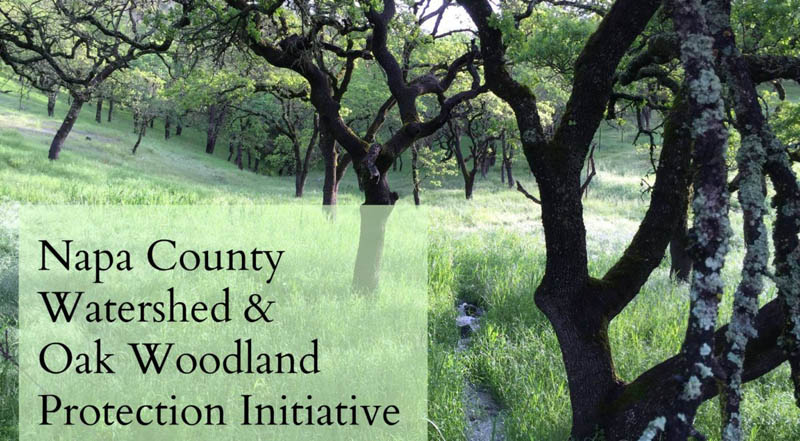
Sierra Club Endorses 2018 Napa County Watershed and Oak Woodland Protection Initiative

By Chris Benz, Chair, Sierra Club Napa Group
Sierra Club has endorsed a ballot initiative to improve protections for Napa County’s watershed and oak woodlands. Voters will face the initiative in June, and, if passed, it will be a historic, precedent-setting measure that will set a limit on how many acres of oak woodlands can be permanently removed.
The Napa County Watershed and Oak Woodland Protection Initiative of 2018 focuses on land zoned for “Agriculture, Watershed, and Open Space,” which makes up the hillsides to the east and west as well as the southern Carneros region of Napa County. The eastern hillsides are a critical watershed area, where the county’s five domestic water reservoirs are located. The water flow from the hillsides is essential to feeding the streams and groundwater of the Napa Valley floor, supplying the needs of farms, residents and wildlife.
Napa residents and environmental groups have long been concerned about increasing development in the hillsides (primarily for vineyards) resulting in the loss of native oak woodlands—which provide vital eco-services such as carbon storage, native habitat, and soil stabilization—and the diversion of groundwater from rural residents and native habitat. This concern intensified with the County’s approval in December 2016 of the 209-acre Walt Ranch Vineyard Development, which will cut down 14,000 trees and sink new wells. (Sierra Club Napa Group is currently in litigation over the Walt Ranch Environmental Impact Report.)
In 2015, Napa residents led by Jim Wilson and Mike Hackett formed a committee to develop this initiative to protect the watersheds and woodlands. Though they collected enough signatures, an election code technicality kept it off the 2016 ballot. A partnership of leaders of the Napa Valley Vintners retooled the initiative for the 2018 ballot to include clearly defined protections and to align with the Napa County General Plan’s vineyard development allowances. These protections include increasing riparian buffer zones of native vegetation surrounding wetlands and streams in the watershed and requiring that three oak trees be replanted or preserved for every one removed. Napa Group Executive Committee members helped collect signatures for the initiative and will be active supporters during the campaign.
Sierra Club Napa Group salutes Jim Wilson and Mike Hackett (longtime members) and the leadership of the Napa Valley Vintners for building on Napa’s legacy of protecting rural lands that began 50 years ago with the creation of our Agricultural Preserve.
As global warming and its consequences wreak more havoc in our local environment, we recognize the critical need to keep our woodlands and watersheds healthy and fully functioning. The Watershed and Oak Woodland Protection Initiative of 2018 will help achieve that goal.
                                                                       *                                  

Friday, January 5, 2018

Heels of the hanged

        Poets say it best, sometimes ahead of the fact.
                                                   
                               
                From W.S. Merwin's Presidents, circa 1970:

                The president of shame has his own flag
                the president of lies quotes the voice
                of God
                at last counted
                the president of loyalty recommends
                blindness to the blind
                oh oh
                applause like the heels of the hanged

                                                              *


Sunday, December 31, 2017

Adios cabernet and pinot?

                           Have a glass of global warming 
                                                                               
                                                                           
Harvard University
Peter Reuell

A changing climate, changing wine
To adapt to warmer temperatures, winemakers may have to plant lesser known grape varieties, study suggests
FINDINGS
A new Harvard study suggests that, though vineyards might be able to counteract some of the effects of climate change by planting lesser-known grape varieties, scientists and vintners need to better understand the wide diversity of grapes and their adaptions to different climates.
JOURNAL
Nature Climate Change

    Cambridge, MA (January 2018) — If you want to buy good wine, Elizabeth Wolkovich says stop looking at labels and listen to your taste buds.
     An Assistant Professor of Organismic and Evolutionary Biology, Wolkovich is among the co-authors of a new study, which suggests that, though vineyards might be able to counteract some of the effects of climate change by planting lesser-known grape varieties, scientists and vintners need to better understand the wide diversity of grapes and their adaptions to different climates. The study is described in a January 2 paper in Nature Climate Change.
    “It’s going to be very hard, given the amount of warming we’ve already committed to...for many regions to continue growing the exact varieties they’ve grown in the past,” Wolkovich said. “But what we’re interested in talking about is how much more diversity of grape varieties do we have, and could we potentially be using that diversity to adapt to climate change.
    “The Old World has a huge diversity of winegrapes – there are over planted 1,000 varieties – and some of them are better adapted to hotter climates and have higher drought tolerance than the 12 varieties now making up over 80% of the wine market in many countries,” she continued. “We should be studying and exploring these varieties to prepare for climate change.”
page1image17760
    Unfortunately, Wolkovich said, convincing wine producers to try different grape varieties is difficult at best, and the reason often comes down to the current concept of terroir.
    Terroir is the notion that a wine’s flavor is a reflection of where, which and how the grapes were grown. Thus, as currently understood, only certain traditional or existing varieties are part of each terroir, leaving little room for change.
    “There’s a real issue in the premier wine-growing regions that historical terroir is what makes great wine, and if you acknowledge in any way that you have climate change, you acknowledge that your terroir is changing,” Wolkovich said. “So in many of those regions there is not much of an appetite to talk about changing varieties.”
    But even if that appetite existed, Wolkovich said, researchers don’t yet have enough data to say whether other varieties would be able to adapt to climate change.
    “Part of what this paper sets up is the question of how much more do we need to know if we want to understand whether there is enough diversity in this crop to adapt wine regions to climate change in place,” said Ignacio Morales-Castilla, a co-author of the study and Fellow at the Arnold Arboretum of Harvard University who investigates which winegrape varieties will adequately mature where under climate change. “Right now we know we have this diversity, but we have little information on how to use it. One of our other suggestions is for growers to start setting aside parts of vineyards to grow some other varieties to see which ones are working.”
    But even if researchers came to the table armed with information about grape diversity, Wolkovich said the industry – both in the traditional winegrowing centers of Europe and around the world – still faces hurdles when it comes to making changes.
    In Europe, she said, growers have the advantage of tremendous diversity. They have more than 1,000 grape varieties to choose from, research repositories such as INRA’s Domaine de Vassal that study this diversity, and expertise in how to grow different varieties. Yet strict labeling laws have created restrictions on their ability to take advantage of this diversity.
    For example, just three varieties of grapes can be labeled as Champagne or four for Burgundy. Similar restrictions have been enacted in many European regions– all of which force growers to focus on a small handful of grape varieties.
    “The more you are locked into what you have to grow, the less room you have to adapt to climate change,” Wolkovich said. “So there’s this big pool of knowledge, and massive diversity, growers have maintained an amazing amount of genetic and climactic response diversity...but if they changed those laws in any way in relation to climate change, that’s acknowledging that the terroir of the region is changing, and many growers don’t want to do that.”
    New World winegrowers, meanwhile, must grapple with the opposite problem – while there are few, if any, restrictions on which grape varieties may be grown in a given region, growers have little experience with the diverse – and potentially more climate change adaptable – varieties of grapes found in Europe.
Just 12 varieties account for more than 80 percent of the grapes grown in Australian vineyards, Wolkovich said, more than 75% percent of all the grapes grown in China are Cabernet Sauvignon – and the chief reason why has to do with consumers.
    “They have all the freedom in the world to import new varieties and think about how to make great wines from a grape variety you’ve never heard of, but they’re not doing it because the consumer hasn’t heard of it,” Wolkovich said. “In Europe, people do blend wines...but in the New World, we’ve gotten really focused on specific varieties: ‘I want a bottle of Pinot Noir,’ or ‘I want a bottle of Cabernet.’
    “We’ve been taught to recognize the varieties we think we like,” she said. “People buy Pinot even though it can taste totally different depending on where it’s grown. It might taste absolutely awful from certain regions, but if you think you like Pinot, you’re only buying that.”
    As Wolkovich sees it, wine producers now face a choice: proactively experiment with new varieties, or risk suffering the negative consequences of climate change.
    “With continued climate change, certain varieties in certain regions will start to fail – that’s my expectation,” she said. “The solution we’re offering is how do you start thinking of varietal diversity. Maybe the grapes grown widely today were the ones that are easiest to grow and tasted the best in historical climates, but I think we’re missing a lot of great grapes better suited for the future.” 
                                                                     *                                                     


Monday, November 20, 2017

Tumble into Jackson Pollock


           The National Gallery of Art in Washington DC owns my favorite painting by the mid-20th century American painter, Jackson Pollock, called Number 1, 1950 (Lavender Mist). So the gallery is the natural venue for Pollock’s largest painting as well, Mural, currently on loan from the University of Iowa Museum of Art.
       Originally painted for the foyer of Pollock’s patron, heiress and gallery owner Peggy Guggenheim, in 1943, it is 20 captivating feet of canvas writhing with bright colors and thick, lavish brush strokes as much in the manner of Pollock’s contemporary, Willem de Kooning, as in that usually associated with Pollock himself. In the painting people find all sorts of things - rising spirits, initials, even spermatozoa.
  So the East Wing’s lovely top floor gallery is a good place to see firsthand all the changes in Pollock’s style, including the final one in his life in which he squirted back paint onto raw canvas with a turkey baster. But despite these forceful images, and Mural's size, it is still Lavender Mist that most powerfully draws the eye to its concentration of seemingly random color drizzles.
       The now-famous technique created separate levels of reality and carries the receptive viewer to incredible depths. Lavender Mist remains emblematic of Pollock’s burst of genius in the early fifties, when the influential critic Clement Greenberg suggested the title. This seems, in retrospect, a too-flip choice (there is no lavender in Lavender Mist), but go judge for yourself.                                 

Wednesday, November 1, 2017

Publishers Weekly gives my book a starred review


 Napa at Last Light: America’s Eden in an Age of Calamity

James Conaway. Simon & Schuster, $26 (288p) ISBN 978-1-5011-2845-5

A
In this fascinating and well-researched book, Conaway delivers an unpleasant portrait of California’s Napa Valley in the 21st century. Conaway knows his subject well, having written two previous narratives chronicling the valley’s metamorphosis over the decades (including Napa: The Story of an American Eden). Several sections of the book explore “specific struggles similar to those all over the country but heightened by Napa’s fame and outsized concentrations of wealth and notoriety.” The 1960s through the ’80s were a golden age for Napa. Newcomers filled with idealism flocked to the valley wanting to learn the art of wine making, all the while respecting sound conservation principles. But once big money arrived, personal bonds among the community members began disintegrating and land-zoning and water-use issues divided Napa residents. Once a mainly mixed-agriculture region that also happened to produce wine, Napa morphed into an oenophile Disneyland, according to Conaway, where new-millionaire winemakers have little regard for the natural environment or quality of life for longtime valley residents. This is a stunning and sad look at how an idyllic community (which has recently been ravaged by fire) became a victim of its own success. (Feb.)Reviewed on 10/27/2017
                           *
https://www.amazon.com/Napa-Last-Light-Americas-Calamity/dp/1501128450/ref=sr_1_3?s=books&ie=UTF8&qid=1509067180&sr=1-3&keywords=conaway
              

Thursday, October 26, 2017

Napa at Last Light reviewed in Kirkus


NAPA AT LAST LIGHT
America's Eden in an Age of Calamity
Author: James Conaway

Review Issue Date: November 15, 2017
Online Publish Date: October 31, 2017
Publisher:Simon & Schuster
Pages: 352
Price ( Hardcover ): $26.00
Price ( e-book ): $13.99
Publication Date: February 20, 2018
ISBN ( Hardcover ): 978-1-5011-2845-5
ISBN ( e-book ): 978-1-5011-2847-9
Category: Nonfiction

In the third volume of his trilogy about Napa, California, Conaway (Nose, 2013, etc.) continues his investigation of the consequences of the wine industry on the region's culture and environment.Both, argues the author persuasively, suffer at the hands of greedy winemakers, huge corporations, and the desire of merchants to attract more and more tourists. As in his past books, this one is filled with detailed—and sometimes overly detailed—sketches of a large cast of characters. Conaway profiles more than 60 individuals who, in one way or another, affect Napa's life and fortunes. These include winery founders, vintners ("mostly an ornamental title nowadays"), growers (a dwindling number), inheritors, and the handful of determined citizens working hard to defend the ecology and integrity of the land they love. The author notes that nearly half of the population of Napa Valley lives at or below the poverty line; housing is "prohibitively expensive, the roads crowded, cancer rates high, and the glaring disparity between incomes growing." But his focus here is not on economic or health problems but rather on environmental damage when agricultural production is impeded by marketing, when wineries are converted "into retail shops, conference pods, and de facto restaurants." Wineries, he writes, have become "self-interested fiefdoms" overseen by astoundingly wealthy vineyard owners, too often international corporations. Some vintners have no knowledge of grape-growing and little interest in the actual work of farming. Many, Conaway writes, "are caught up in what amounts to a parody of viticulture, elaborate dramas of money and celebrity far removed from the dust from which hope springs eternal." One man, seeking "self-realization" as a vintner, confessed that he wanted to make "a difference to people and their experiences," which, Conaway says scornfully, "is what real estate development and tourism are all about, not agriculture." The author ends on a "guardedly optimistic" note, citing citizens' successes in holding back development and exploitation. A strong plea for responsible stewardship of the land.
                                                *
https://www.amazon.com/Napa-Last-Light-Americas-Calamity/dp/1501128450/ref=sr_1_3?s=books&ie=UTF8&qid=1509067180&sr=1-3&keywords=conaway


Wednesday, October 25, 2017

Napa Confidential: The Fire So Far

                                             The Private I                                                                                                        
While the mighty Atlas Fire has been contained, it is by no means out, and there is no way to assess the damage along Atlas Peak, Soda Canyon and through the hills east/north of Yountville.

I did catch one resident of Circle Oaks (evacuated) who commented the community was completely surrounded by fire, but the fire department put up a huge stand and saved their subdivision.  This suggests Walt Ranch's forests were lost/are lost to the fires.  Roads remain closed as crews continue to work the interior of the various fires, and while people were escorted back so they could fetch documents at Circle Oaks, I think they remain displaced for now.

Don't know if the MiniWalt/Kongsgaard's property survived, or what the situation is around Miliken Creek and the Hall's reputedly just-completed water filtration plant, and Walt Ranch.  My best guess is the forests burned.  I'm sure a stand was made to try to save the Miliken plant, but it was involved so early on, before firefighters arrived en mass.

What saved the ridges from Sonoma's east side that spilled into Napa's west side (actually south side directionally) were changes in winds and serious efforts by air: 727s and 737s with sodium borate and lots of helicopters, including the heavy-life Chinooks of Columbia Helicopters that deliver just under 60,000 gallons/hour of water, quieting things down and protecting hotshorts down below.   They systematically worked the many points between Yountville and Zinfandel Lane where the fire came over ridge lines into the county and prevented losses on that side of the valley. We won't know much for some time.
                                                                        

I just watched the St. Helena City Council meeting, and Chief Sorenson had photos of where our volunteers served and prevented the fire from spreading from the Tubbs Fire in Calistoga down to St. Helena and protected us by making a stand at Petrified Forest on Petrified Forest Road, and put out embers that blew from the engulfed area across the road before they could do damage to "our side."

The Chief reported that St. Helena was the first truck on the Atlas Fire.  They had been called to join other units battling a blaze that began earlier in the day at the huge auto dismantler's location with acres of cars.  Hundreds of cars were lost.  They were released from that fire about 9:15, and moved along up the valley when from Hwy. 29 they noticed a red glow and spotted the fire ... they immediately headed to Atlas Peak Road via Silverado Trail and were able to save lots of people who were stuck with fire fast approaching ... 10 cars of people coming down the hill from Atlas Peak sealed off from escape by a burning tree that had fallen across the road.  They got the tree out of the way and the people to safety and were called right to the Tubbs Fire back beyond St. Helena.


Unreal.  Nothing spoiled in views really from Yountville up on the west side until past Calistoga from the main highway.  I'm sure it's a mess from Silverado Trail Napa to Yountville, however.  The Atlas burned to the valley floor and took some wineries and vineyards with it.
                                                      *