Wednesday, January 30, 2013

Go: Vancouver


  Something happens to the traveler in Vancouver, British Columbia, that is both delightful and paradoxical. This the most remote of the northwest’s coastal cities should inspire, with its dry, cool summers and air seemingly brushed clean by Pacific breezes, the sort of hard work and cultural reserve associated with north European settlers. Instead, Vancouver surrounds the newcomer with an almost Mediterranean light and sensuality, a farrago of languages other than English, a dedication to physical exertion, and Anglo-Saxon efficiency.
In this new world Amsterdam backed by gorgeous mountains and surrounded by water, do not miss Stanley Park, the extensive – 1,000 acres - maritime landscape protruding like a vernal thumb into English Bay in the city’s west end that astounds newcomers with its beauty, size, and remove, as well as its practical, unfussy preservation. What’s left of the extensive temperate rainforest that once blanketed the continent’s entire northwest coast here acts as the urban foil, a remarkable triumph of nature over development and the myriad pressures of big city life.
My introduction to Stanley Park was serendipitous: I had booked a room at the nearby, historic (1912) Sylvia Hotel, despite a warning in an otherwise reliable American guidebook that the Sylvia was “old fashioned.” So what? Worn gentility merely added to the charm of old-timey, ivy-covered but stylishly efficient digs long favored by artists, writers and professors. A Vancouver Heritage Site, the practically-priced Sylvia had big windows that actually opened and a greensward spread out front like an enormous, living doormat.
The first thing I noticed about Stanley Park and its immediate surroundings was absence - of noise, billboards, contention. The park drew natives and visitors, walkers and bench sitters, granola-ites and gourmands when they might otherwise have been working, drinking, eating, looking at art, or riding one of the cameo passenger ferries bobbing on inland waterways. In Stanley Park people walked, jogged, rode bicycles, and skated in-line on designated paths as if they simply enjoyed it, without elaborate regalia or self-righteous determination.
An introductory stroll took me along the edge of salty, kelp-   filled water remarkable for its clarity in the presence of shipping and industry, with thick undergrowth on my other side, presided over by towering cedars, hemlocks, and firs that have grown up in the 120 years since the peninsula was logged. The entire loop is more than five miles, and I determined to walk it early the next morning, and to learn about the park’s provenance and what diversions its resurgent forest offered.

Stanley Park was established in 1886, after the land was leased by the Canadian government for Vancouver’s benefit. This was the city’s first preserved green space, and although Vancouver today has almost 200 parks, Stanley is by far the largest. Once part of the Musqueam and Squamish Indian nations, it was named for Governor General of Canada, to be managed by a board independent of successive politicians.
The seawall, built primarily to prevent erosion but also as the foundation of a continuous walkway, had been started in 1920 and worked on for 60 years. The elevated promenade, along with the park’s other distractions, accommodates 8 million visitors a year and sets an example of a preserved natural landscape for cities everywhere. It’s lovingly used by joggers and aging, apparently pleased, arm-swinging heart rate enthusiasts. I passed the famous statue of the girl in a diving mask, perched on a rock. Big container ships hung far out in the morning mist, but the overall feeling was bucolic. The five and a half mile wake-me-up offers a 240-degree view of the sprawling bay, passes beneath the towering modern span linking downtown with the city’s North Shore, and passes by Coal Harbor and Lost Lagoon.
I discovered two good restaurants, both requiring the navigation of narrow, one-way roads cosseted by giant trees. The straight-forwardly named Fish House was built in 1930 as a sports pavilion and later remade into a restaurant that today has both quality seafood and a wine list with plenty of Canadian wines. But it was the Sequoia Grill that for me held the most promise, touted by more than one native as the second best restaurant in Vancouver after Rain City Café around the corner from the Sylvia Hotel.
Formerly this historic wooden structure on Ferguson Point was been used by the Canadian military during World War II and transformed into a tea House 1978. Then, with fanfare – marching band, cannon firing, flag ceremony, Reveille – transformed again, this time into a restaurant overlooking English Bay and the North Shore, with a glass conservancy and lots of fireplaces. I sat down I sat under a glass ceiling and sipped good British Columbia sparkling wine. The maitre’d came with a long metal rod and closed the overhead windows against the growing chill of evening on the continent’s northwest edge.
I was hungry from wandering, and the safe menu reassured: Digby scallops, baby spinach and pear salad, Queen Charlotte crab cakes, bouillabaisse. It didn’t seem to matter what I ordered, since the medley of food spread around me on white tablecloths, discreetly attacked by a multi-national clientele, served as visual smorgasbord. The highlight proved not to be caloric, however, but scenic: a brilliantly orange sun dipping into blue-gray water that led to collective sighs.

The next day I took a little ferry to famous, from a dock within walking distance of Stanley Park. These quaint little craft hold a dozen people and on the half-hour ply the entrance to False Creek, charge only two Canadian dollars, and offer a lovely civic panorama. Granville Island’s a refuge for artisans and artists, a bazaar for foodies, a boating mecca, cultural potpourri, and parking place for reefs of bicycles.
The Wooden Boat Society of Canada had brought together gorgeous, hand-crafted kayaks, rowboats, sailboats, and bridge-deck schooners for everyone to gawk at; the galleries offered, in addition to original painting and sculpture, African carvings, Indian weaving, handmade jewelry, and so on. It seemed that most (innocent) human appetites could be satisfied here, but it was the fresh produce and meat market that really held sway.
Arrayed in vast, connected sheds were scores of stalls that sold, among everything else, dried horse meat and whole king salmon, ducks’ necks, smoked buffalo, pig’s ears, boneless Irish hams, a universe of salamis, huge, glossy blackberries, Canadian figs, local cheeses, gorgeous fresh vegetables, cut flowers in bundles, fuscia in pots that in a climate like Vancouver’s grow up to be bushes, and an infinity of variations on these themes. There were no announcements, radios, or piped-in music, just rivers of sedate, wide-eyed people, local and otherwise, moving in something close to awe through this daily cornucopia best dipped into before noon.
I gathered some Genoa salami, ripe camembert, olives, a crusty French roll, and figs, and happily ate at a table outside, with a view of the harbor. It was, of course, time to do what is required of all dutiful tourists, heritage and otherwise – re-cross the water, hail a cab, and stroll through Gastown, with its famous steam-powered clock, or the Vancouver Art Gallery; take a turn through the third largest Chinatown in North America; troll boutique-y Robson Street; find my way to one of Vancouver’s many lush, rain-swaddled gardens.

Saturday, January 26, 2013

Bloggers, northward!

                                                                             
    The 2013 Wine Bloggers Conference, held last year for three rollicking, informative days in Portland, OR, is being held this year further north, in Penticton, British Columbia. I recommend attending for both enjoyment and a chance to meet experts and to taste new wines, etc. For details and a look at the program go to: http://winebloggersconference.org/america/agenda/
    I was in Portland for last year's conference and learned a lot. I'm being honored this year with a slot in the program and am looking forward to it. Also to expanding my knowledge of that part of the Pacific Northwest. Although the conference isn't in Vancouver, one of the great North American cities, it's close enough to attract some attendees. Later I'll post a piece about my own expereinces in Vancouver, with recommendations for food, etc.

Wednesday, January 23, 2013

Bottle-stock: Super Tuscan Napan


    The reason this bottle looks empty is that we drank it all. That’s proof enough that it tasted good, but more is required in this case. The wine comes from the famous Dario Sattui of Castelllo di Amorosa, which is not in Italy but northern Napa Valley and one of the most authentically-assembled, intriguing structures ever to grace that New World version of Tuscany (or Provence, or whatever Mediterranean association you prefer).

    Fittingly, the 2008 La Castellana (“The Lady of the Castle”) is a “super Tuscan,” which means, as you know, a blend of Bordeaux varieties (70% cabernet sauvignon, 16% merlot) and  the more southerly sangiovese (14%). It makes this wine more enticing at an early age and adds to the remarkable depth of flavor. Generally, the Lady’s a testament to the distance Sattui has traveled in wine-making, as well as in architectural daring, and another indication of the inter-relatedness of the global vineyard.

Friday, January 18, 2013

Drink: Jack Rose, America's biggest (best?) whiskey bar


Appropriately, it’s in the nation’s capital – in scruffy, forever interesting Adams-Morgan: long granite bar, towering shelves of spirits, notably bourbon and scotch (including the world’s peatiest single malt, Bruichladdich’s Octomore 5.1), a drinks menu longer than both your arms and legs, with labels ringing bells for more than a century. Portions come in 1- and 2-ounce shots, many from arcane bottles reached with the aid of old library ladders; bartenders are knowledgeable, the clientele mellow (how could it not be?), the founder a self-confessed elbow-bender and former performance poet, Harvey Fry, whose long white beard, mariner’s gaze, bandana, overalls, and bottomless trove of whiskey knowledge pleasantly enable and entertain.

Sunday, January 13, 2013

This is an except from my novel appearing in American Scholar

Cotton

All he wanted was to work his land in peace, never knowing that what mattered most to him was about to be taken away


Wednesday, January 9, 2013

Drink: Rummy


    The fortunate are off to Aruba or St. Maarten or Jamaica, or about to be, when they are not off to Sun Valley or Gstaad. But rum is one of the few drinks versatile enough to suit most any clime. The demon goes swimmingly with boiling water and a touch of cloves in a glass with a silver spoon. Devotees drink it in the American West and in Switzerland, where rhum grog is served aprés-ski. But it’s better sipped under an equatorial sun with tonic or fruit juice, or just shaved ice, while the shaded eye takes in blue sky and water. Rum was not invented in the Caribbean but perfected in those latitudes, and today its mellow charm accounts for a large chunk of the U.S. spirits market.
     The history of rum is tied up with that of sugar cane, which supposedly was first brought back from India by Alexander the Great three centuries before the birth of Christ. Not until the middle of the seventh century did it arrive regularly in Europe, by Arabian caravan, probably from the South Pacific. Speculation has it that Columbus took sugar cane to the West Indies on his second voyage, and it was from there that this alcoholic product of fermented and distilled sugar cane juice first became available when Spanish settlers in the 16th century began making and exporting it.
   Although written records from Barbados in 1600 contain a recipe for rum punch, the origins of the name itself are obscure. Some say it derives from the Latin name for sugar cane, others attribute the name to the British Navy, where an admiral known as “Old Rummy” prescribed rum as an antidote to scurvy. Rum is perhaps our most romantic beverage, as rich in history as in calories. We associate it with the discovery of America, West Indian adventurers, pirates, and the Spanish Main. Rum was a favorite of the American colonists for the same reason it’s popular today - it tastes good, and is relatively cheap.
   Allegedly Paul Revere got pumped up on rum before shouting about the approaching British, and George Washington was elected to the Virginia House of Burgesses by distributing 75 gallons of rum to his constituents. Before the Civil War rum was also made in New England and part of an infamous trading cycle: sugar cane imported from the Caribbean was made into rum; this was sent to Africa to purchase slaves; these were sent to the West Indies to buy more sugar cane, profits raked off at every stop.
   During Prohibition, rum found its way through the swamps of Florida and Louisiana to many a cocktail glass,and even today rum carries a raffish association. To make the stuff, sugar cane is crushed immediately after harvest and then boiled to concentrate the sugar. Most of the sugar’s removed by centrifuge, but the molasses that’s left is still quite sweet. Distinct styles of rum are produced by distilling either the cane juice or the molasses, varying the time and amount of distillation, aging in wood, and adding caramelized sugar.
Rum’s available in distillations that range from 80 to 151 proof. With a few exceptions, the lower the proof the more complex the flavor.
   Americans have always liked mixtures of rum and fruit juice or coconut milk. Although the daiquiri and the pina colada make good vehicles for high-proof rum, the best way to drink it is neat. Rums from the islands of the Caribbean and some South American countries are often filtered to make them light in color and body, and high in alcohol. Puerto Rican and Cuban rums are commonly 100 proof, and are big sellers, but usually not as flavorful as other versions. Flavorful, heavier rums often come from the English-speaking islands, notably Jamaica, and the process for making them is more involved. The residue of previous fermentations, known as “dunder,” is added to a new batch of molasses, and then a natural, leisurely fermentation is allowed to occur. The fermented juice is distilled twice, which produces clear liquor, and then aged in oak casks. Caramelized sugar is added for deep color in Jamaican and other heavier rums (and also used to improve the appearance of cheap brandies and other spirits).
   Haiti and Martinique make rum from sugar cane juice, rather than molasses. It is aged in oak and comes close to French brandy in delicacy. Barbancourt, of Port-au-Prince, makes a number of grades and uses stars on the labels to distinguish among them. The Barbancourt Five Star, tasted blind in a snifter, could fool a connoisseur of cognac. From Martinique comes La Manny, aged in Limousin oak and also with the allure of a good brandy. I recommend plain ole Mount Gay, from Barbados, however, with medium body and good flavor. It goes well with Schweppes, or simply with ice and a squeeze of lime juice.

Sunday, January 6, 2013

The mysterious grape

   This from the Science section of the NYT, about the variations among grapes in the same vineyard. (Hint: it's microbial.) My interest is selfish, rather than scientific, since the plot of my novel hinges on the identity of a wine that can be discovered only though creative analysis:

http://www.nytimes.com/2013/01/01/science/same-grapes-can-vary-by-location-in-vineyard.html?ref=science

Wednesday, January 2, 2013

A generous review

By Michael Perlis, contributing editor of Eve's Wine (evewine101.com):

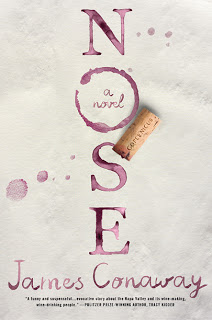
NOSE, a novel
Copyright 2013, 320 pages
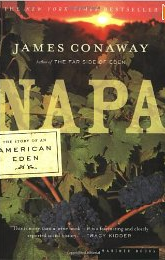
NAPA: THE STORY OF AN AMERICAN EDEN
Copyright 1990, 529 pages
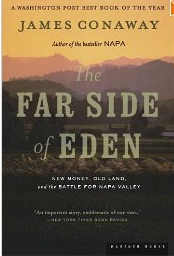
THE FAR SIDE OF EDEN
Copyright 2002, 381 pages
All by James Conaway:
NAPA: THE STORY OF AN AMERICAN EDEN, published in 1990, and THE FAR SIDE OF EDEN, published in 2002, together present a fascinating history of the development of Napa Valley.


     I don’t necessarily review current books. I typically acquire books that happen to catch my eye, regardless of publication date, and then get around to reading them sometime later – often a lot later. But, not to worry as both non-fiction books are still available.
     That being said, the first book mentioned above, NOSE, is about to be published (more about it later), the second covers the history of the Napa Valley from the mid-1960s through the 1980s (along with looks back to earlier times), and the third book picks up where the second left off, taking the reader through the next decade.
     Very well written, and very interesting to read about the people originally behind some of the iconic wineries still around today, as well as those wineries no longer with us. The books also give great insight into the various forces and factions that shaped the development of the area – the growers, vintners, investors, conservationists, developers, and of course the politicians.
     I definitely recommend reading these books, particularly if you are planning a trip to the area.  Sometimes seeing those famous names, especially the mega-wineries, one forgets that they were started by people just like us. As is often the case, some became victims of their own success and became huge and attractive to large corporate suitors. Did wine quality suffer as a result? Well, that is only for the reader/taster to judge. Fortunately, Napa (and wine regions in general) always see an influx of new talent with the right pioneering spirit to continue to excite us with great wines to please our palates.
Photo by PeterMenzel
     Conaway is the author of several other books, has written for numerous magazines, as well as being a renowned artist.  I had the opportunity to speak to Conaway to ask him if he had any plans to add a third volume to his non-fiction Napa series. Well, the answer to that question was “maybe”, but I was very excited to hear about his novel coming out March 2013, called NOSE, which takes place in “Northern California wine country”. While the site is non-specific, Conaway said it includes elements from “Napa, Sonoma and Mendocino counties”.  Taking place after the “Bush crash, post 2008”, the book, while written as entertaining fiction, looks at current issues in wine country as well as focusing on wine critics, bloggers, and that perfect bottle of wine.
    Conaway also maintains a blog: http://cjonwine.blogspot.com/ which I suggest you check out.  You can read the advance Kirkus review of NOSE there, along with a lot of other interesting stuff.
And contrary to what I said at beginning of the article, NOSE is one book I am really looking forward to reading as soon as it comes out. Conaway will be touring when the book comes out, so stay tuned for updates on when he will be in Southern California.

Monday, December 31, 2012

The end is here....

     Well, it has been a full year since I started this blog and readership has grown from a handful of hits to thousands. I have expanded the coverage to include things only tangentially related to wine and plan to continue. I will include in the new year my own experience of having a novel published that's ostensibly about the fine wine business but is really the story of making it in America - and holding onto your own cherished piece of it. And I will bring back Nose himself, the indefatigable sleuth in the imaginary valley of northern California's Caterina River, the original inspiration for this blog.
     Many of you true oenophiles have been patient with this amateur's less-than-rigorous approach to the subject, and I'm grateful. I hope you had a happy and reasonably sodden New Year's Eve.
       
Here are the favorites for 2012:

The Red Room:  http://cjonwine.blogspot.com/2012/03/sniff-sniff_23.html

The Joys of a Small Cellar:  http://cjonwine.blogspot.com/2012/09/the-joys-of-small-cellar.html

Controlled Fire: http://cjonwine.blogspot.com/2012/05/controlled-fire.html

Bottle Stock: Smith-Madrone: http://cjonwine.blogspot.com/2012/08/bottle-stock-smith-madrone.html

Hands Across the Sea: http://cjonwine.blogspot.com/2012/08/hands-across-sea-jcb-no3.html

If It's Not in the Vineyard:  http://cjonwine.blogspot.com/2012/03/if-its-not-in-vineyard-its-not-in-glass.html

There's a Fly in My Glass: http://cjonwine.blogspot.com/2012/04/a-fly-in-my-glass.html

Dr. Silvius's Revenge: http://cjonwine.blogspot.com/2012/03/dr-silviuss-revenge.html


Pretentious Punts: http://cjonwine.blogspot.com/2012/04/pretentious-punts.html


The East Coast's Most Expensive Cab: http://cjonwine.blogspot.com/2012/03/east-coasts-most-expensive-and-best.html


 So You Think You Have a Wine Club: http://cjonwine.blogspot.com/2012/11/so-you-think-you-have-wine-club.html


Beyond the Paris Tasting: http://cjonwine.blogspot.com/2012/05/beyond-paris-tasting.html


The Napa-ization of the Willamette: http://cjonwine.blogspot.com/2012/12/the-napa-ization-of-willamette.html

Saturday, December 29, 2012

Bottle stock: Single field tequilas


    From the New York Times cocktail specialist, Toby Cecchini. I haven't tried this version of Ocho but do know the cheaper blanco version (merely $40), an introduction provided by my friend and tequila fan Randy Dunn. That Ocho, too, has the "primordial vegetal embrace of agave" the writer speaks of, plus a smokey undercurrent. Straight, or with a lime slice, it's very, very good. 


Tequila Ocho Single Barrel, Potencia de la Barrica 109.2 proof/54.6 percent, $75
Tomas Estes is an American who has devoted his life to tequila. He owns a number of restaurants in Europe based around the spirit and has, over the past few years, nurtured a small, ferociously curated label of single-origin beauties, Ocho, made by the cult distiller Carlos Camarena, the man at the dials of El Tesoro, Tapatio and Excellia, among other brands. Estes has also just released a book about his odyssey of a life in pursuit of tequila. Whenever people ask me what they should buy for a friend who likes tequila, I often reply “anything from Ocho.” This creature, a lightly tinted añejo delivered without any filtration and at barrel strength, is such an anomaly it can’t help but stand out. The only thing that I ask from a real tequila is that it carry across some of that primordial vegetal embrace of the agave from which it’s made. So many lack even a trace of it. This beauty has that covered with so much to spare. Every time I approach it I get new sensations: along with a touch of wood, grilled tropical fruits, minerals, camphor, horehound candy. How do you drink it? Not in margaritas. Despite its potency, it is a perfectly genteel sipper.
   

Friday, December 28, 2012

Report: The Napa-ization of the Willamette?

An edited version of my earlier piece in Gourmet and an indication of demands made on vineyard land that are re-surfacing in Oregon with a vengeance:

From this high, fallow hill you can see much of Oregon’s famous Willamette Valley where pampered pinot noir vines march off in neat formation toward scattered settlements and woods and fields thst comprise a kind of visual agrarian homily. Oddly enough, this bucolic setting, where swallows dip in the soft evening light, became the site of land use struggles so familiar in Napa valley and other viti-cultural venues. Controversy was limited to “how big the corn dogs would be at the annual Turkey-rama,” according to Jason Lett, winemaker at Eyrie Vineyards, and a leading opponent of a planned five-star hotel here.

In worn jeans, rimless glasses and beard shadow, Jason didn’t much resemble his late father, David, who left the Napa Valley back in the ‘sixties to prove that good pinot could be grown in the Dundee Hills. He entered his 1975 South Block Reserve pinot noir in the blind tasting held in Paris in ’79 that included the world’s best pinots, including wines of Robert Drouhin. Eyrie won, inspiring disbelief and consternation overseas and etching Oregon pinot onto the vinous world map.

Lett and two other pioneers, David Adelsheim and Richard Ponzi, began to travel together around America, proselytizing to the trade about their wines. Comity and mutual assistance were taken for granted in those days, when all the Willamette vintners could fit into Nick’s restaurant in McMinnville. Today Nick’s requires reservations, in large part because of tourists attracted by agriculture. To sacrifice vineyards is to harm both that business, and quality wine-making. As David Lett said of the plan to build the hotel, “People turned out to be greedy, and dumb.”

Many narrative lines converge on this particular hill, most of them happily. Half-way down is the Douglas fir where nesting redtail hawks gave rise to the name, Eyrie. Jason Lett grew up almost in that tree’s shadow, eating Pacific staples his father got by trading away Eyrie’s Pinot Blanc — “it went great with salmon and Dungeness crab” — when money was tight. Jason took over as winemaker and today successfully emulates his father’s style of wine and has another of his own.

Look to the left and you will see the roof and extensive, closely-spaced vines of Domaine Drouhin, proof that Robert Drouhin himself decided, after the fateful 1979 tasting, that if this New World terroir was serious stuff, why not buy some? Today Domaine Drouhin produces— ironically — the more up-front, luscious style pinot noir, while Eyrie, devoid of new oak, is leaner and more classically structured.

    Farther down the hill sits the Sokol Blosser Winery, founded by Bill and Susan Sokol Blosser in 1977. They, along with David Lett, helped convince Yamhill County to terminate what was then five-acre residential zoning, so vines could be planted instead of houses. “The American ethic of ‘I can do whatever I want with my property’ has got to change,” said son Alex, referring to the prospect of a hotel rising from green waves of vitis Vinifera. And he echoed the sentiment heard often here: “We don’t want the Napa-fication of the Willamette.”

The Willamette isn’t Napa. It’s too large, for one thing, and too diverse. Two hundred and fifty commercial crops are grown, whereas Napa’s trellised monoculture occupies every square foot of tillable land. By contrast, the views from wineries spread around the northern Willamette — from Elk Cove to Bethel Heights, from Amity to Cristom — are of fields of grain, cattle, wood lots, and rolling country with some vineyards and mercifully few McMansions.

The Dundee hills come closest to the Napa Valley analogy: many wineries, concentrated wealth, a couple of aspiring châteaux, and traffic jams on Highway 99 down on the valley floor. This resembles Napa’s Highway 29, but here more of the cars are bound for the Spirit Mountain casino than for tasting rooms. The highway passes through the towns of Newberg, Dundee, Lafayette, and McMinnville, which has a well preserved historic downtown that attracts tourists and an occasional limo. B&Bs have sprung up in the Dundee Hills, too.

Enter now David Kahn, in pristine white sneakers, stepping from the red Lexus he used as an extension of his Portland real estate office. He and his investors had development rights on the hilltop. Kahn wanted nothing more, he told me, than to bring world-class R&R into the coveted heart of Oregon pinot-dom, and to help everybody in the process. “It can be done here,” he said, meaning that a five-star hotel and spa would prosper in the midst of so much rural eye candy. He lovingly referred to his proposed hotel as “the Auberge de Soleil of the Willamette,” referring to that $600 minimum-a-night “inn” that clings to a mountainside above Napa Valley, where tourism has come to rival — and challenge — agriculture.

Kahn lauded the number of private jets that he had seen in the air over Napa, and other high-end manifestations in that crowded Eden, including the specialty cuisine-cum-condiment boutique, the Oakville Grocery, which he called “the greatest place on earth.” Such enterprises greatly stimulate the local economy, he pointed out, and would here, too. But both it and Auberge de Soleil were grandfathered in; they could not be built there today.

This hill in Dundee, however, could support vines, despite its altitude, as proven by those growing all around it. Oregon has long prided itself on the preservation of its agriculture. Long-standing land use laws prohibit commercial projects in the midst of farmland because they interfere with farming and permanently remove the land from the possibility of ever being farmed. Additional issues with Kahn’s proposed hotel included a falling water table, increased traffic, sewage, various sorts of waste—including, possibly, brine brought up from deep marine sediments where well-diggers would likely have to go—and permanently altered views from below.

Two dozen vintners joined hands and signed a letter opposing Kahn’s project, but Yamhill County’s three-person governing board of commissioners granted him an exception anyway. The sole Democrat on the board, Mary Stern, a lawyer, said she had no choice but to vote for the exception because Kahn and his lawyers proved to her satisfaction that a five-star hotel could succeed nowhere else in the county. “If I could have voted against it,” she said, “I would have.”

But the vintners’ lawyer said that the county had no idea where such high-impact facilities should go, or how they should function. “It shouldn’t be done on an ad hoc basis. We need a comprehensive plan.”

“Kahn’s bill passed,” said Lett, “simply because a lot of people with a lot of money want to stay in wine country.” Among the hotel’s other opponents was Domaine Drouhin’s manager, David Millman. “The hotel’s a great idea,” Millman admitted over a glass of chardonnay on Domaine Drouhin’s deck, “but in the wrong place. Kahn couldn’t do this in Burgundy, or in Napa.”

The county commissioners’ ruling went to the Land Use Board of Appeals and ended up in Oregon’s court of appeals. After deliberating for many white-knuckled weeks, the court asked for an extension, an indication of the importance of the case and the novel questions it raised. The court sent the application for the hotel back to the Land Use Board of Appeals for further consideration. Both protection of farmland and growing urbanization had to be better addressed in granting such exceptions, the court said.

Vintners in the Willamette fretted then over the generally roiled state of land-use law in Oregon, where the notorious Measure 37 referendum, which passed in 2004, allowed some residential development in ag zones after a hiatus of 40 years. A new referendum, Measure 49, designed to counter Measure 37, narrowly passed but only patched up the damage done by the earlier one.
Although the prospects of any luxury spa capping the Dundee hills dimmed and finally were extinguished, it was clear that pro-development sentiment in rural Oregon wasn’t going away.

Wednesday, December 26, 2012

The Wire: Stealth developers in the temple of pinot

    The latest tip from the Willamette Valley is disturbing in its implications: "I think you might find what's going on in Oregon quite interesting.  A group of pro-development  wineries have taken control of the Oregon Wine Board and are using winery legislation to undermine Oregon land-use law."
     If vineyards and wine are used to weaken the state's inspired and long-standing land use policies, it would be both ironic, and tragic. A luxury hotel in the middle of some of the best vineyards in America was narrowly defeated in recent years in the Willamette  (I'll post a condensed version of the story I wrote about it for the last issue of Gourmet), and everyone thought thesue settled. Apparently it isn't.

Tuesday, December 18, 2012

Read with pleasure (I hope)

This is a review from Bill Marsano's blog, Poured with Pleasure, which I liked a lot even before he reviewed my novel: pouredwithpleasure.com

James Conaway’s earlier and excellent non-fiction books on Napa Valley’s heroes and villains [read those, too] inspired his fiction: Nose, a mystery that’s funny, witty and murder-free. The plot’s maguffin is a wine: a mysterious Cabernet that tantalizes Napa no end and provides targets for Conaway’s sharp elbows: cult wineries, ridiculous geekspeak, self-important bigshots, land abusers, chemical polluters, and the overall cheapening of Napa’s heritage [although I guess they call it a ‘brand’ these days]. Also lifestyle pomposity and hard-eyed lawyers, courtesy [da-dum!] of a blogger who knows too much. A blogger hero? Who knew?

Thursday, December 13, 2012

Go: Chicago, city of pig shoulders


     “Chicago’s not the city of big shoulders, it’s the city of pig shoulders,” said Phil Ponce, television news anchor on Channel 7 and a local celebrity, peering into the new, up-scale Gene’s Deli in north Chicago’s Lincoln Square, at the amazing array of sausages dangling from overhead racks. It was Sunday afternoon and the streets were jammed with strollers enjoying what was once the enclave of Germans and eastern Europeans but now it was a more diverse neighborhood with a new steel archway proudly announcing “Lincoln Square” and dozens of shops and galleries.

     Here sustainable urbanism applies to restaurants, since they are one of the city’s great draws. Xoco, a mile north of the Loop, was designed for a chef renowned for his Mexican dishes, a television show, and ecological and social concerns, Rick Bayless. His restaurant was a bright, narrow space with a kitchen in the front window, full of wonderful smells of chiles and slow-cooked meats, packed with people waiting for sumptuous caldos and tortas baked in the wood oven. Electricity costs were kept down by substituting a combination of incandescent and LLD lighting for more efficiency without losing the friendly glow. And the vents over the stoves were specially designed to reduce heat loss, a revolutionary step. “All materials used come from within 500 miles of here. You can’t tell, but it makes me happy.” He added, “People don’t get lectures on environmental ethics, just good food.”

Next door were two other Bayless restaurants, Topolobampo and Frontera, an ecologically-concerned Mexican culinary island a mile north of the Loop. Bayless’s offices were upstairs, where he wore a chef’s jacket even when behind his desk. “If we don’t manage our resources better, we’ll run out. Our children will face much harsher realities.” He supported the “locavore” notion of buying food from within that 500-mile radius, including vegetables grown within city limits.

That included those from City Farm, started by social activist Ken Dunn in the impoverished Cabrini-Green neighborhood, part of what Dunn called “addressing the community’s needs,” a concept he wanted to see applied to the whole city. “This was once the poorest tract in the nation,” said Dunn, driving me in his little red Honda to an intensely cultivated truck garden next to a housing development. This formerly abandoned property belonged to the city and was a real, and profitable, horto in urbs. “It will stay this way as long as we can sell hand-grown arugula, Brussels sprouts and rainbow chard to up-scale restaurants.”

For context I decided to visit a couple of Chicago’s old-line eateries not known for their ecological concern. The one favored by pols and sports stars, Gibson Steakhouse, was the prime venue for 10-ounce Martinis and red meat. “Have you seen the show?” asked the waitress, showing me a tray on which are arranged slab of raw protein. I chose the charcoal broiled “W.R. Chicago Cut,” an extra thick rib-eye with bone attached, and it arrived between layers of carcinogens like book covers. But in between was some of the best beef I’d ever tasted, accompanied by a potato the size of a small football, under a blanket of melted Wisconsin cheddar, sort of local, but definitely not lo-cal. Then came a slab of “Texas” pecan pie too large for the saucer. “Don’t worry,” I’m told by a woman sitting nearby, “food hanging over the edges of plates is very Chicago.”

     Another hoary stand-by, the Cape Cod Room in the historic Drake Hotel, had low ceilings and lots of nautical art on the walls. It was a favorite port of the good ship Metameucil, judging by all the gray heads hovering over scallops wrapped in bacon, and snapper in papillote. Enough of the old stand-bys, I thought, on to the new, like Avec, west of the Loop, like a boxcar paneled with natural wood and packed with thirty-somethings, shoulder-to-should at community tables, knoshing on the famous medjool dates stuffed with chorozo and wod-oven braised pork shoulder with Prince Edward Island mussels and tripe. I was beginning to realize that eating out in Chicago is a complicated endeavor that transcends politics and ecology, and traditional favorites having their own spin and fierce defenses.

Like the Reuben egg roll from a local vendor in the Richard Daly Civic Center Plaza; the strong, creamy cappuccino from Intelligentsia cafes; crispy fried Lake Erie perch and tempura-like lemon slices in the airy Terzo Piano restaurant at the Art Institute; enchiladas with pork and red chile sauce in Leon in the Latino quarter known as Pilsen, south of the Loop. And sausage in most any guise, most anywhere in the Second City, a name settled on Chicago back in the 1950s, in a New Yorker article by the late A.J. Liebling suggesting that Chicago couldn’t measure up to Manhattan.

Well, Chicago has given the world the car radio, mail-order sales (Montgomery Ward), the television remote, and the Otis elevator that enabled Manhattans, too, to ascend, and… the North Pond Café in Lincoln Park is near the zoo, the Lincoln Park Conservatory, and the relatively new Peggy Notebaert Nature Museum. The ambitious menu could be perused while overlooking North Pond, and seared fois gras with wild huckleberries and roasted wild wood pigeon happily consumed in the cozy atmosphere of earlier times. This stand-alone structure isn’t just surrounded by parkland, but its interior is also done in natural wood, with a quote on the wall from Thoreau: “In wilderness is the preservation of the world”


Excerpted from my piece for National Geographic Traveler

Tuesday, December 11, 2012

Report: Patrick O'Connell's - and the Inn's - salad days


      What follows is the chef's account of launching his career and that of the Inn at Little Washington, taken from my notes for an earlier magazine piece:
         
             If you have a desire to cook, all you need is an audience.

The Inn’s an outgrowth of the home table. We bought a house in 1972 on the county line. The mountain folk had stacks of wrecked cars. Trailers and school buses were starter homes. The number of food stamps you received depended upon which county your kitchen was in. I had read philosophy in college and realized that everyone has a geographical place, and that this was where I belonged.

Cooking was something you did if you couldn’t find a real job, by people who weren’t quite acceptable. I had studied theater at Catholic University and found restaurant people stimulating. America had no real chefs at that time, so I decided to take a year off and go to Europe. It was a revelation to see how Europeans viewed chefs. I saw then that this was my career.

I worked for two years in Charlottesville, then at Chez Francoise near Washington, D.C. Meanwhile I researched restaurant possibilities in Rappahannock County. This was a country store with a junk yard, garage, and an outhouse. I rented half of it for $200 a month, and borrowed money to build a kitchen in what had been the garage’s grease pit. It’s now the living room. Locals all asked, “Why are you doing this? Who’s coming?” The idea that people would drive all the way out here from D.C. just to eat was unthinkable.

French cuisine was the only one Americans took seriously then. Julia Childe was an inspiration for me. The feeling of a restaurant in France was what I wanted to convey – a sense of place reinforced by food and cooking. But all the classic French country dishes – kidneys, sweetbreads, frogs’ legs – were considered wildly exotic. I had one kitchen boy and two wait staff. I didn’t think there would be enough weekday visitors, so then I would just cook and serve. Then the first weekend night we had 75 people. The reviewer for The Star asked me if I was sure I wanted him to write about us, and his review changed everything.

I would take reservations in the kitchen. In the mornings I would go to the Florida Avenue market in D.C. and buy food for the evening and pile it in the old Dodge Dart. Then I found someone to go to the market for me. One day he was very late. People were waiting for their food, so I served them all a demitasse of soup, to buy time, and it became a tradition.

What we dealt with in those days was hysterically funny. We served an awful lot of iced tea in the beginning. One woman asked if the soft-shell crabs could be fresh way out here, and I said, “They’re so fresh they haven’t even arrived yet.”

The kitchen helper wore a doo rag and wouldn’t eat the food. He brought his own bologna sandwiches. One night when we ran out of food I asked if he had anything in his car, and he said, “Sack of plums.”

I said, “Get them,” and made a plum sauce and served it on shrimp.

We started getting our herbs and vegetables locally and realized they were so much better. We would trade and barter. Everybody had an excess of something. They would bring zucchinis as big as your arm, and I said I want them the size of your finger. “Can’t make no money on that,” they’d say, and I said “I’ll pay for them - four times as much.”

            Eventually we trained local 50 farmers to provide us. We became known for regional American cuisine, one of the first. People were realizing how much better it was, and that they should eat seasonally. It created a lot of interest, and we offered our own kind of French country cooking. I’m still expanding on that idea. People want to be able to walk through the cherry and apple orchards, and the herb garden. Americans were learning, and they craved another experience. If they could take something back with them, it increased their enjoyment.


            Turning point came when I exercised the option to buy the place. It led to the development of rooms, and a garden where the junkyard was. I wanted a fantasy, something that felt like it had been here a hundred years. It needed a patina of an authenticity. We sent the architectural drawings to Joyce Evans. She had been a pupil of the British architect who did interiors for the royal family, and could render a phone booth to look like a ballroom. She sent back a watercolor that was amazing.

In the off-season every year we traveled to the great restaurants of the world, and started to go to the great country houses in England, Ireland, France. We made a list of the best, and soon realized that France had the best food and England and Ireland the best taste in country houses, the most charming and comfortable. So we did an American adaptation of those. Joyce patterned our kitchen after the cheese and dairy room at Windsor Castle. The hallmarks are the ceilings, too often neglected in America. They’re the last thing you see at night and the first thing you see in the morning, and set the tone. They must invoke an enveloping feeling.

    Joyce has been here for more than 25 years. We gave her an unlimited budget, and she exceeded it. Initially she chose the fabrics, wall coverings, and furniture and bought it over there. Then we became her only client.

     Ours is never an adaptation but a refurbishing of old buildings in Little Washington from the American colonial period. She had also done a lot of stage and costume design, and understood what a great restaurant needs – it has to both evoke drama, and make you smile when you walk in. The eye can never absorb it all. On your tenth visit you’re still noticing things because we strive for a layered feeling, something that only we can bring about.

     It has evolved like that for 30 years. Joyce has the drapes put in, lined and inter-lined. It’s so different from the way tings are done in America. When you’re dealing now as we are with five-star inspectors you have to look hard for the flaws. The patina is so important – for instance, a carpet must have the right amount of wear, showing that important people have walked there. We live in an age when the average restaurant fails in three years, and this is all part of the strategy to keep the Inn going.

     When you grow something like this from a grease pit, you can’t shake that memory. No one could replicate this because it has been evolving for three decades. It’s never static – that’s the key. I think of it as a garden, always being pruned and tweaked, elevating everything to the same level. We look daily for tangible changes. I would have become bored years ago if it was all just about the food.

     You need a point of view that reflects the creator’s evolution. Just like you can’t serve food you don’t want to eat, you can’t create an environment you don’t want to be in. But as you grow your taste changes. If you’re not embarrassed by what you did a year ago, you’re not progressing. To create this level of sophistication, so close to that original shack, is very exciting. Even living in that old shack I wanted dinner to be formal, as if in London.

Still, sometimes I open the frig and something falls out, and I think, “Of course! Use it! Black-eyed peas under fois gras!”
 

Thursday, December 6, 2012

Eat: The Inn at Little Washington


   The façade has the requisite white columns expected in the Old Dominion, and a handsome door held for you by a smiling young man in black livery. Step into what can be described as a full-press sensory adventure decked out with richly layered fabrics on walls and ceilings, tapestries, fireplaces with polished mantles, oriental vases, antiques of muted splendor, and original oils more Constable than Wyeth.
   Your primary reaction won’t be awe – there’s that, too – but keen anticipation: You’ve come to dine. So follow the hostess across a dense carpet on a wide-board floor from a 17th century French chateau. You have driven from wherever to Washington, Virginia, older than its namesake on the Potomac 67 miles to the east, a well-preserved bit of the historic piedmont graced with beautiful Colonial brick houses and a view of the Blue Ridge reminiscent of the Yorkshire Dales.
   Here are period chairs to ease into, and an icy glass of champagne at the ready. “Everything has a story at the Inn,” says the man who created it, chef Patrick O’Connell, “just as it might in someone’s house.” He wears the signature Dalmatian print apron and has taken a break from his fabled kitchen. “Everything’s unique. The goal is to take you to a place you’ve never been.”
   The knowledge that this was once a general store and auto mechanic’s shop doesn’t interfere with his vision or temper the amazement that the strikingly original menu engenders. He started the Inn in 1978, which became a literal overnight success, and bought it soon afterward. It was inundated by diners eager to come all the way from Big Washington and beyond; it has received the highest professional accolades, from the AAA and Mobil Travel Guides to Zagat’s Washington DC Restaurant Survey and the James Beard Foundation. 
  “What movie set do you want to be in?” Patrick asks. This one’s a grand souffle of Atonement and Babette’s Feast, although he and his helpmate, London set designer Joyce Evans, would probably find such comparisons lame. The recent $5 million remodeling of kitchen, eight bedrooms, six suites, and two guest houses has maintained the aura of age and privilege traditional at the Inn, Evans’ only client. All the furniture has been shipped from England, for instance. “The place has become a folie in the best sense,” Patrick adds, laughing. “The food by itself wouldn’t be enough.” 
     In the kitchen are silver chalices and an incense burner, droll visual metaphors for what Patrick refers to as “the temple.” Here the holiest of holies is prepared on a massive new center island range in British racing green, under a brass and copper canopy, by sous chefs in the same black-and-white aprons. All dishes must pass beneath the chef’s critical eye before being released to expectant diners. 
    Take a seat at a corner banquette in the dining room, under a fringed lampshade, and unfold a big, crisp, white napkin. The first course is a culinary contrast: four fresh Island Creek oyster “slurpies” on the half-shell, each topped with different ices – cucumber, passion fruit, wasabi, and cocktail sauce – and brimming with the essence of ocean. Another is the explosive Mediterranean medley of crispy Rouget in gazpacho with an olive tapenade crouton.
   This is followed by an elegant Napoleon of wild mushrooms in a kind of froth of mushrooms, butter, and shallots. The stacked layers of phyllo, wild mushrooms, and fresh herbs look like it has been snowed on by a Parmesan cloud and conveys a delectable seasonal earthiness in an enduring Inn standard. The pan-seared Peking duck breast comes from nearby Four Story Hill Farm and is served on one of the many white plates specially designed for particular dishes, this one deep, with broad shoulders, accentuating the four slices of duck breast fanned on a bed of creamy corn pudding and surrounded by a dark reduction of braised cherries. The triumph of this particular creation is the distinct, “real” taste of very different, very fresh components.
    Various bubble teas made of fruit plucked almost within sight emanate from Little Washington. This day it’s strawberry, a perfect, palette-resuscitating transition to the final indulgence: homemade mint ice cream draped with chocolate streamers. This lays the taste buds happily to rest and completes an intimate acquaintanceship with local ingredients transformed through the minor miracle of French country cooking and American inventiveness into something entirely, yes, unique.
    “It’s never static here,” Patrick has said. “I think of the Inn as a garden, always being pruned and tweaked, elevating everything to the same level. Just as you can’t create an environment you don’t want to be in, you can’t serve food you don’t want to eat.”

    From Veranda

Saturday, December 1, 2012

For all things Napan...


     People ask me sometimes what's happening in Napa, as if I should know. Generally I don't, but Paul Franson most definitely does, the Renaissance-esque creator of NapaLife and the valley's insider (http://www.napalife.com, and paul@napalife.com). Paul's NapaLife Insider's Guide to Napa Valley can be held in your hands, as it's a real book available on the website and an indispensable accoutrement in the luggage of those Napa-bound.