Tuesday, February 12, 2013

Letter from Maui


After a long absence from this blog, the indefatigable Doc Lang has just checked in again, this time from the South Seas:

   Aside from Spam dishes for breakfast, lunch and dinner
and that Polynesian favorite - white rice with mayonnaise
and potatoes - Hawaiian cuisine has lately come up with a
food with mainland appeal - beer. Two microbreweries in the
islands are producing ales, lagers and porters that are as
good as suds get. Maui Brewing and Kona Brewing are little
known outside the islands, which consume nearly all the
output, but both are expanding and and becoming more
available especially on the West Coast.
   I think flavored beers generally have the lasting appeal
of flight attendants making cutesy PA announcements. Kona
offers one spiced with coriander and mandarin oranges (I
didn't dare). But both micro-breweries produce porters with
roasted coconut that are subtle, avoid sweetness, and are
worth the belch.      
     Doc offers this as a crucial part of "the library of
     Hawaiian cuisine"

Friday, February 8, 2013

New excerpt: The Interloper

     In this, from the novel due out March 12 from Thomas Dunne Books (St. Martin's Press), the famous wine critic encounters his worst nightmare.
    (For earlier excerpts, go to Post Coitum (2/2/13) and Cotton (1/13/13).  


An hour and twenty minutes later after the tasting began, Clyde Craven-Jones leans back in his wheeled throne and sighs. Nine bottles down, and not a clear winner. He thinks he knows who made half of them, and can come close to guessing the rest. Two hover in the mid- to-upper teens of his twenty-point ranking system, which will make their investors moderately happy, but no ecstasy in this tasting. If the mystery wine’s among them, then it’s merely good.
The brown wrapping paper disguised the last bottle, emblazoned with the number 10, the poured wine in the Riedel deeply hued. He pulls the glass to him, picks it up by the stem and quickly, deftly twists his wrist, driving the wine high up the sides. Its concentrated fragrance reaches him even from that distance. He dips his nose directly into the invisible pool of inspiration and inhales. He’s impressed by the wine’s power, and annoyed: surely this is not the mystery bottle, which means he failed to detect the interloper among the previous nine. He scribbles “... barely ripe black fruit... toasty... a lean, shimmering nimbus of cassis.”
He takes a mouthful and holds it for a moment, lips parted, drawing air in over the wine, then closes his mouth and, without swallowing, exhales through the nose, pushing the sacred “ether of harvest and extracted oak,” as he often puts it in his lectures, back out through his nostrils, with a surprising result. He’ll describe it as “reverberating cabernet bells.” St. Paul’s? Too grandiose. A chapel? Too parochial. This wine tolls on the nose with all the power and precision of Christopher Wren’s gem, the Church of Mary Le Bow... If you can fully appreciate that complex melody you’re not Cockney, you’re enchanted!
He swallows, the cascading flavors identifiable, married in an onslaught of what he thinks of as the essence of Bordeaux, not California – elegant, balanced, with a long trail on the palate that dwindles into the soothing convergence of light and shadow in a distant clearing... Yes, that will do nicely. The wine might well be one of Bordeaux’s best, from a first-growth estate, introduced as a joke. Detectable tannins, but overall so silky as to be forgiven. Less heat around the gums, meaning relatively low alcohol.
It could represent the glory of France, but the initial, decisive burst of fruit and lingering ripeness has the power of California. Has someone finally managed to make a wine in the valley with the contradictory merits of France and America, or is this a con? If so, it’s near the top of the chart and worth a great deal of money.
He takes a fistful of popcorn and crams it into his mouth, snowing all over his sweats. Now for the sobering second swallow, the true test. He tears the wrapper off the bottle and is confronted by a column of dark liquid in generic glass; that he has no idea whose this wine is or where it came from is humiliating. A wine critic without self-confidence is - how did he put it at the Friends of Wine lecture in San Francisco the week before? - in the evening of his being.
In the frenzy of stripping No. 10 he has upset No. 6, spilling inky cabernet over the white table cloth. He attempts to mop it up with the wrapping paper, without success. More tearing to expose the other bottles, an array of family and fanciful names - Eagle Ridge, Block 69, Trifecta, Copernicus. He knows them all and he knows their makers; No. 10 is indeed the interloper.
CJ confronts the wreckage of his tasting, takes another swallow: Ah, is there anything better than a glass of fine red wine of an afternoon? Well, of a morning, actually. He can feel the alcohol now, not just No. 10’s but the collective onslaught of the wines he has absorbed despite spitting, a hazard of his profession.
He peruses his notes. Numbers 2 and 5 - Block 69, and Trifecta - are clearly the stand-outs, after No. 10. What comes next is tricky. He stands and pads to the hallway door, opens it a crack, softly whistles. Then, “Missy.”
A scrabble of claws on heartwood Doug fir, a blur of brindle hair ejecting from the bedroom, smiling if a mastiff can be said to smile, her soft brown eyes full of anticipation. He reaches down and digs his fingertips into her wiry coat, but the dog brushes past him.
CJ eases the door shut and returns to the disarray of the tasting. Bracing himself with one hand, he slowly kneels, groaning, and places the two winners on the floor while Missy watches, a timeless scene: dog, master, quarry, older than history.
“Go!”
Missy creeps forward and tentatively smells each glass in turn. She settles on Trifecta.
“Back!”
She obeys, still eying the glasses as if they might take flight, and waits while he crawls forward, carefully blocking her view. He replaces Block 69 with No. 10. If Missy picks the mystery wine, this will compliment his olfactory abilities since she’s infallible, and very close to his own palate.
He crawls out of the way, sweeping aside wine-soaked wrapping paper and dropped pencils. Spilled wine drips through the crack between the leaves in the table; popcorn litters the carpet.
“Go!”
Used to the drill, Missy sniffs at Trifecta, then at the interloper, hesitates, and stays with the nameless wine. “Ah,” says CJ proudly, since it’s his choice, too. He has to remind himself - down on all fours himself - that this colleague is, after all, just an animal.
  
Next: Glass Act 


Saturday, February 2, 2013

Post coitum


An excerpt from the novel, due March 12 from Thomas Dunne Books (St. Martin's Press), in which the famous wine critic is challenged:


Claire rose on one elbow, exhaled, and said with a smile, “Well, BTDT,” a jocularity intended to make her husband feel better about his, well, supine performance. True, he had been there, but he hadn’t done that. No matter; the day beckoned. “Anything special in the line-up?”
“Yes, you’re going to be challenged today, CJ. By this valley’s own. Nine cabernets in the up bunch,” which meant costing at least one hundred and thirty dollars a bottle.
“Why not ten cabernets?” It was the usual arrangement of American grands crus.
“Well, the tenth one’s a mystery. No label, nothing. I want to include it because it seems special and has been around for a bit. Arrived in a lovely cedar box, wrapped in a Pashmina shawl.”
Those things meant nothing. Vintners spend small fortunes encapsulating mediocre wine in a way that makes it seem of a higher order, the same logic used for building their expensive houses and wineries. Packaging, like labels, was deception. One of his duties as a premier wine critic – the premier wine critic, he liked to think - was to out deception in Craven-Jones on Wine, with its pass-along readership of, he often insisted, more than a million. “How did it get here?”
“By hand, that’s all we know.”
Why hadn’t the dog alerted them? Clyde Craven-Jones didn’t allow wine to be left on his doorstep; only the most audacious – or stupid – would attempt it. But he was curious, and any worthy critic welcomes the random chance to test his mettle. Besides, Claire had gone to the trouble of including it. “Let’s begin.”
Solemnly launching himself into a roll, the massive, custom-made bed protesting feebly, his wife nimbly getting out of the way. She went into the bathroom and he heard water filling a tub designed for corpulence beyond the American standard, with special handles for easing himself in and out. He thought he caught a trace of something floral – tansy? camellia? His policy was no manufactured fragrances of any sort in the house, perfume being the worst, an assault fraught with plant renderings and mysterious chemical compounds that gave him an immediate migraine and affected his ability to taste. He demanded plain soap for his morning immersion, baking soda for his toothbrush, an electric razor for the graying scrim of beard accenting copious, signature jowls.
 

            In team velour sweats – a gift from a wine distributor, unsolicited but comfy – and rope-soled espadrilles, Clyde Craven-Jones moves with deliberation from his boudoir to a hallway lined with cheaply-framed photographs of himself with every personage in the wine world who matters, among them two of his late countrymen, noble, modest scholars of the grape and fine practitioners of the English language, both dead now.
            He’s the last of the ranking Brits and long ago succumbed to the allure of the New World, with its lack of ceremony, its un-blinkered heat that even in the straw-hued mirage of summer he finds preferable to the damp determinism of his native land.
And, of course, the California wines themselves: heavily extracted, endowed with strangely-scented variants that his English colleagues found perverse but he has come to admire for their richness and power. He’s responsible for much of that intensity, favoring in his reviews those cabernets and pinot noirs with some flesh on their bones, much to the disgust of the French who have been made to compete with California and what’s sometimes called “the Craven-Jones style,” lest they languish on shelves absorbing light and drying out like old men abandoned in a sauna.
He pushes open the door. The organ that matters most to him – that distinctive protuberance bigger than other men’s, more sensitive, gifted, in fact, beyond the bounds of ordinary human perceptiveness – his nose, has guts of its own. Also the ability to raise its lucky owner to the top of his profession and into the company of some of the wealthiest, most talented, sometimes most reprehensible people on earth, an appendage so remarkable in it has appeared in the pages of a leading newsweekly: slightly hooked, increasingly veiny, near-infallible.
 The former dining room is heavily draped, temperature controlled, with overhead tract lighting, racks of Riedel glasses in every imaginable contortion for concentrating aromas, open cartons of wine, unlined writing pads, 3B drawing pencils - no pens! - a sterling spitting bucket with splash guard, and, on the white tablecloth, ten bottles neatly wrapped in brown paper by his obliging wife and numbered by her current assistant, the perpetually distracted James. One of a procession of helpers in love with wine, soon disabused of the notion that caddying for the critic is a spiritual pastime, he has removed the foils and poured an equal amount of wine from each bottle into a stemmed glass elegantly constricted at the rim.
CJ pauses, slightly elevating his nostrils, priming them with a barely perceptible twitch, angling in the direction of the sideboard. He has detected an alien odor among the familiar ones. Ah, the felt pen, left behind with the top off, the acrid smell emanating from evaporating ink. “Ja-hames!”

The door swings open and in steps the ingratiating amanuensis. In Bordeaux he would be wearing, at the very least, a buttoned-up shirt, but in California it’s open-necked rugby-style, with jeans: the uniform. Fuzz on the chin, smiling - everyone in California smiles - the young man’s big, brown eyes denoting apprehension. “What’s up, CJ?”
“The Magic Marker’s up, James.”
“Shit. Sorry about that.”
James scoops it up, smacks the cap in place and goes back through the revolving door. A handsome lad, maybe a tad too handsome, chastened but overdue for remaindering; has Claire found something of value in James beyond his ability to heft wine cartons, open bottles, and run the dishwasher? (No detergent!) But now Craven-Jones is distracted by the right smells: cabernet sauvignon’s infinity of masked components, its glorious potential enhanced by caresses of cabernet franc, petite verdot, merlot, even malbec, as well as oak and the panoply of botanical associations that push all else from his mind and bring to his palate an anticipatory wetness.
Almost daintily he takes his chair and eyes the delectable prey. The tease before the main event, the vinous equivalent of a naked woman walking around a boxing ring holding aloft a placard with a number on it. Where are the muscles and firm flesh, where the flab? Who will have the up-front power and fruit, who the longest finish in this match-up of potential champions? Sports references are absolutely necessary for communication in this, his chosen country, but CJ knows little of sport beyond the terrible memories of rugby in the damp desolation of his Midlands preparatory school. Metaphorically, he favors sumo wrestling: enormous combatants pushing at each other, stately, powerful.
At his elbow sits a cut-glass bowl full of air-popped corn, sans butter and salt, the perfect palate cleanser: weightless mopper-up of all vestiges of sampled wine. The popcorn’s smell reminds CJ of his gnawing hunger, to be put off until lunch, which today will commence with wafer-thin sole fillets over which scalding French butter has been poured, no other cooking required, complemented by a slightly chilled Puligny-Montrachet.

He’s getting ahead of himself; dining follows due labor, the reigning Craven-Jones maxim. Meanwhile no flaw shall pass this nose, these lips, this palate, without detection, no short-coming shall go unannounced in what Claire calls his doomsday book, Craven-Jones on Wine, printed on actual paper, with a paid circulation of one hundred and twenty thousand and a pass-along influence of, yes, a million. Craven-Jones on Wine often breaks, as well as makes, reputations, vintages, business deals, marriages, even lives. Such is his power and, of course, his burden.
Ready now, nasal chambers cleared with a mild saline solution, his copiousness fondly settled into the custom-made, re-enforced rolling chair set high enough to prevent his having to bend his knees, he passes flared nostrils over the glasses first, guessing the species of oak from which the barrels were made that until recently held these gems. Limoge? Alliere. My God, Arkansas! He will soon know exactly who made the wines and how long the fruit hung on the vines, the blend, the barrel regimen, the fining agent, and how well they sell on the futures market depends upon his evaluation.
He picks up a glass by the stem and angles it, examining the color against the white table cloth. Deeply mauve, cabernet’s own depthless version of purple, concentrated to the rim. Ah, these New World hues. His fellow Brits reeled in their presence, but CJ came to love them as a deliverer from the anonymous life of bottle drudge in the chilly cellars of Lily & Sons, Ltd., City of London, scribbling reviews for the firm’s news-sheet, before he branched out under a pseudonym.
Compressing now one nostril with a forefinger and passing the glass under the other, he inhales deeply. The olfactory equivalent of matins in a village chapel go off in a brain inculcated with associations: black cherries, currents, brambles, lanolin, tobacco, cedar, chocolate. But also flaws: blatant woodiness – it’s well known that Clyde Craven-Jones disapproves of harsh tannins – and a good but hardly spectacular finish.
He ejects a purple stream into the bowl, scribbles “gobs of fruit. . . too-rapid falling off on the middle palate. . . predictable,” and moves on to the next bottle.
 

  Next: The interloper

Wednesday, January 30, 2013

Go: Vancouver


  Something happens to the traveler in Vancouver, British Columbia, that is both delightful and paradoxical. This the most remote of the northwest’s coastal cities should inspire, with its dry, cool summers and air seemingly brushed clean by Pacific breezes, the sort of hard work and cultural reserve associated with north European settlers. Instead, Vancouver surrounds the newcomer with an almost Mediterranean light and sensuality, a farrago of languages other than English, a dedication to physical exertion, and Anglo-Saxon efficiency.
In this new world Amsterdam backed by gorgeous mountains and surrounded by water, do not miss Stanley Park, the extensive – 1,000 acres - maritime landscape protruding like a vernal thumb into English Bay in the city’s west end that astounds newcomers with its beauty, size, and remove, as well as its practical, unfussy preservation. What’s left of the extensive temperate rainforest that once blanketed the continent’s entire northwest coast here acts as the urban foil, a remarkable triumph of nature over development and the myriad pressures of big city life.
My introduction to Stanley Park was serendipitous: I had booked a room at the nearby, historic (1912) Sylvia Hotel, despite a warning in an otherwise reliable American guidebook that the Sylvia was “old fashioned.” So what? Worn gentility merely added to the charm of old-timey, ivy-covered but stylishly efficient digs long favored by artists, writers and professors. A Vancouver Heritage Site, the practically-priced Sylvia had big windows that actually opened and a greensward spread out front like an enormous, living doormat.
The first thing I noticed about Stanley Park and its immediate surroundings was absence - of noise, billboards, contention. The park drew natives and visitors, walkers and bench sitters, granola-ites and gourmands when they might otherwise have been working, drinking, eating, looking at art, or riding one of the cameo passenger ferries bobbing on inland waterways. In Stanley Park people walked, jogged, rode bicycles, and skated in-line on designated paths as if they simply enjoyed it, without elaborate regalia or self-righteous determination.
An introductory stroll took me along the edge of salty, kelp-   filled water remarkable for its clarity in the presence of shipping and industry, with thick undergrowth on my other side, presided over by towering cedars, hemlocks, and firs that have grown up in the 120 years since the peninsula was logged. The entire loop is more than five miles, and I determined to walk it early the next morning, and to learn about the park’s provenance and what diversions its resurgent forest offered.

Stanley Park was established in 1886, after the land was leased by the Canadian government for Vancouver’s benefit. This was the city’s first preserved green space, and although Vancouver today has almost 200 parks, Stanley is by far the largest. Once part of the Musqueam and Squamish Indian nations, it was named for Governor General of Canada, to be managed by a board independent of successive politicians.
The seawall, built primarily to prevent erosion but also as the foundation of a continuous walkway, had been started in 1920 and worked on for 60 years. The elevated promenade, along with the park’s other distractions, accommodates 8 million visitors a year and sets an example of a preserved natural landscape for cities everywhere. It’s lovingly used by joggers and aging, apparently pleased, arm-swinging heart rate enthusiasts. I passed the famous statue of the girl in a diving mask, perched on a rock. Big container ships hung far out in the morning mist, but the overall feeling was bucolic. The five and a half mile wake-me-up offers a 240-degree view of the sprawling bay, passes beneath the towering modern span linking downtown with the city’s North Shore, and passes by Coal Harbor and Lost Lagoon.
I discovered two good restaurants, both requiring the navigation of narrow, one-way roads cosseted by giant trees. The straight-forwardly named Fish House was built in 1930 as a sports pavilion and later remade into a restaurant that today has both quality seafood and a wine list with plenty of Canadian wines. But it was the Sequoia Grill that for me held the most promise, touted by more than one native as the second best restaurant in Vancouver after Rain City Café around the corner from the Sylvia Hotel.
Formerly this historic wooden structure on Ferguson Point was been used by the Canadian military during World War II and transformed into a tea House 1978. Then, with fanfare – marching band, cannon firing, flag ceremony, Reveille – transformed again, this time into a restaurant overlooking English Bay and the North Shore, with a glass conservancy and lots of fireplaces. I sat down I sat under a glass ceiling and sipped good British Columbia sparkling wine. The maitre’d came with a long metal rod and closed the overhead windows against the growing chill of evening on the continent’s northwest edge.
I was hungry from wandering, and the safe menu reassured: Digby scallops, baby spinach and pear salad, Queen Charlotte crab cakes, bouillabaisse. It didn’t seem to matter what I ordered, since the medley of food spread around me on white tablecloths, discreetly attacked by a multi-national clientele, served as visual smorgasbord. The highlight proved not to be caloric, however, but scenic: a brilliantly orange sun dipping into blue-gray water that led to collective sighs.

The next day I took a little ferry to famous, from a dock within walking distance of Stanley Park. These quaint little craft hold a dozen people and on the half-hour ply the entrance to False Creek, charge only two Canadian dollars, and offer a lovely civic panorama. Granville Island’s a refuge for artisans and artists, a bazaar for foodies, a boating mecca, cultural potpourri, and parking place for reefs of bicycles.
The Wooden Boat Society of Canada had brought together gorgeous, hand-crafted kayaks, rowboats, sailboats, and bridge-deck schooners for everyone to gawk at; the galleries offered, in addition to original painting and sculpture, African carvings, Indian weaving, handmade jewelry, and so on. It seemed that most (innocent) human appetites could be satisfied here, but it was the fresh produce and meat market that really held sway.
Arrayed in vast, connected sheds were scores of stalls that sold, among everything else, dried horse meat and whole king salmon, ducks’ necks, smoked buffalo, pig’s ears, boneless Irish hams, a universe of salamis, huge, glossy blackberries, Canadian figs, local cheeses, gorgeous fresh vegetables, cut flowers in bundles, fuscia in pots that in a climate like Vancouver’s grow up to be bushes, and an infinity of variations on these themes. There were no announcements, radios, or piped-in music, just rivers of sedate, wide-eyed people, local and otherwise, moving in something close to awe through this daily cornucopia best dipped into before noon.
I gathered some Genoa salami, ripe camembert, olives, a crusty French roll, and figs, and happily ate at a table outside, with a view of the harbor. It was, of course, time to do what is required of all dutiful tourists, heritage and otherwise – re-cross the water, hail a cab, and stroll through Gastown, with its famous steam-powered clock, or the Vancouver Art Gallery; take a turn through the third largest Chinatown in North America; troll boutique-y Robson Street; find my way to one of Vancouver’s many lush, rain-swaddled gardens.

Saturday, January 26, 2013

Bloggers, northward!

                                                                             
    The 2013 Wine Bloggers Conference, held last year for three rollicking, informative days in Portland, OR, is being held this year further north, in Penticton, British Columbia. I recommend attending for both enjoyment and a chance to meet experts and to taste new wines, etc. For details and a look at the program go to: http://winebloggersconference.org/america/agenda/
    I was in Portland for last year's conference and learned a lot. I'm being honored this year with a slot in the program and am looking forward to it. Also to expanding my knowledge of that part of the Pacific Northwest. Although the conference isn't in Vancouver, one of the great North American cities, it's close enough to attract some attendees. Later I'll post a piece about my own expereinces in Vancouver, with recommendations for food, etc.

Wednesday, January 23, 2013

Bottle-stock: Super Tuscan Napan


    The reason this bottle looks empty is that we drank it all. That’s proof enough that it tasted good, but more is required in this case. The wine comes from the famous Dario Sattui of Castelllo di Amorosa, which is not in Italy but northern Napa Valley and one of the most authentically-assembled, intriguing structures ever to grace that New World version of Tuscany (or Provence, or whatever Mediterranean association you prefer).

    Fittingly, the 2008 La Castellana (“The Lady of the Castle”) is a “super Tuscan,” which means, as you know, a blend of Bordeaux varieties (70% cabernet sauvignon, 16% merlot) and  the more southerly sangiovese (14%). It makes this wine more enticing at an early age and adds to the remarkable depth of flavor. Generally, the Lady’s a testament to the distance Sattui has traveled in wine-making, as well as in architectural daring, and another indication of the inter-relatedness of the global vineyard.

Friday, January 18, 2013

Drink: Jack Rose, America's biggest (best?) whiskey bar


Appropriately, it’s in the nation’s capital – in scruffy, forever interesting Adams-Morgan: long granite bar, towering shelves of spirits, notably bourbon and scotch (including the world’s peatiest single malt, Bruichladdich’s Octomore 5.1), a drinks menu longer than both your arms and legs, with labels ringing bells for more than a century. Portions come in 1- and 2-ounce shots, many from arcane bottles reached with the aid of old library ladders; bartenders are knowledgeable, the clientele mellow (how could it not be?), the founder a self-confessed elbow-bender and former performance poet, Harvey Fry, whose long white beard, mariner’s gaze, bandana, overalls, and bottomless trove of whiskey knowledge pleasantly enable and entertain.

Sunday, January 13, 2013

This is an except from my novel appearing in American Scholar

Cotton

All he wanted was to work his land in peace, never knowing that what mattered most to him was about to be taken away


Wednesday, January 9, 2013

Drink: Rummy


    The fortunate are off to Aruba or St. Maarten or Jamaica, or about to be, when they are not off to Sun Valley or Gstaad. But rum is one of the few drinks versatile enough to suit most any clime. The demon goes swimmingly with boiling water and a touch of cloves in a glass with a silver spoon. Devotees drink it in the American West and in Switzerland, where rhum grog is served aprés-ski. But it’s better sipped under an equatorial sun with tonic or fruit juice, or just shaved ice, while the shaded eye takes in blue sky and water. Rum was not invented in the Caribbean but perfected in those latitudes, and today its mellow charm accounts for a large chunk of the U.S. spirits market.
     The history of rum is tied up with that of sugar cane, which supposedly was first brought back from India by Alexander the Great three centuries before the birth of Christ. Not until the middle of the seventh century did it arrive regularly in Europe, by Arabian caravan, probably from the South Pacific. Speculation has it that Columbus took sugar cane to the West Indies on his second voyage, and it was from there that this alcoholic product of fermented and distilled sugar cane juice first became available when Spanish settlers in the 16th century began making and exporting it.
   Although written records from Barbados in 1600 contain a recipe for rum punch, the origins of the name itself are obscure. Some say it derives from the Latin name for sugar cane, others attribute the name to the British Navy, where an admiral known as “Old Rummy” prescribed rum as an antidote to scurvy. Rum is perhaps our most romantic beverage, as rich in history as in calories. We associate it with the discovery of America, West Indian adventurers, pirates, and the Spanish Main. Rum was a favorite of the American colonists for the same reason it’s popular today - it tastes good, and is relatively cheap.
   Allegedly Paul Revere got pumped up on rum before shouting about the approaching British, and George Washington was elected to the Virginia House of Burgesses by distributing 75 gallons of rum to his constituents. Before the Civil War rum was also made in New England and part of an infamous trading cycle: sugar cane imported from the Caribbean was made into rum; this was sent to Africa to purchase slaves; these were sent to the West Indies to buy more sugar cane, profits raked off at every stop.
   During Prohibition, rum found its way through the swamps of Florida and Louisiana to many a cocktail glass,and even today rum carries a raffish association. To make the stuff, sugar cane is crushed immediately after harvest and then boiled to concentrate the sugar. Most of the sugar’s removed by centrifuge, but the molasses that’s left is still quite sweet. Distinct styles of rum are produced by distilling either the cane juice or the molasses, varying the time and amount of distillation, aging in wood, and adding caramelized sugar.
Rum’s available in distillations that range from 80 to 151 proof. With a few exceptions, the lower the proof the more complex the flavor.
   Americans have always liked mixtures of rum and fruit juice or coconut milk. Although the daiquiri and the pina colada make good vehicles for high-proof rum, the best way to drink it is neat. Rums from the islands of the Caribbean and some South American countries are often filtered to make them light in color and body, and high in alcohol. Puerto Rican and Cuban rums are commonly 100 proof, and are big sellers, but usually not as flavorful as other versions. Flavorful, heavier rums often come from the English-speaking islands, notably Jamaica, and the process for making them is more involved. The residue of previous fermentations, known as “dunder,” is added to a new batch of molasses, and then a natural, leisurely fermentation is allowed to occur. The fermented juice is distilled twice, which produces clear liquor, and then aged in oak casks. Caramelized sugar is added for deep color in Jamaican and other heavier rums (and also used to improve the appearance of cheap brandies and other spirits).
   Haiti and Martinique make rum from sugar cane juice, rather than molasses. It is aged in oak and comes close to French brandy in delicacy. Barbancourt, of Port-au-Prince, makes a number of grades and uses stars on the labels to distinguish among them. The Barbancourt Five Star, tasted blind in a snifter, could fool a connoisseur of cognac. From Martinique comes La Manny, aged in Limousin oak and also with the allure of a good brandy. I recommend plain ole Mount Gay, from Barbados, however, with medium body and good flavor. It goes well with Schweppes, or simply with ice and a squeeze of lime juice.

Sunday, January 6, 2013

The mysterious grape

   This from the Science section of the NYT, about the variations among grapes in the same vineyard. (Hint: it's microbial.) My interest is selfish, rather than scientific, since the plot of my novel hinges on the identity of a wine that can be discovered only though creative analysis:

http://www.nytimes.com/2013/01/01/science/same-grapes-can-vary-by-location-in-vineyard.html?ref=science

Wednesday, January 2, 2013

A generous review

By Michael Perlis, contributing editor of Eve's Wine (evewine101.com):

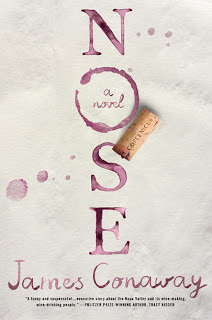
NOSE, a novel
Copyright 2013, 320 pages
NAPA: THE STORY OF AN AMERICAN EDEN
Copyright 1990, 529 pages
THE FAR SIDE OF EDEN
Copyright 2002, 381 pages
All by James Conaway:
NAPA: THE STORY OF AN AMERICAN EDEN, published in 1990, and THE FAR SIDE OF EDEN, published in 2002, together present a fascinating history of the development of Napa Valley.


     I don’t necessarily review current books. I typically acquire books that happen to catch my eye, regardless of publication date, and then get around to reading them sometime later – often a lot later. But, not to worry as both non-fiction books are still available.
     That being said, the first book mentioned above, NOSE, is about to be published (more about it later), the second covers the history of the Napa Valley from the mid-1960s through the 1980s (along with looks back to earlier times), and the third book picks up where the second left off, taking the reader through the next decade.
     Very well written, and very interesting to read about the people originally behind some of the iconic wineries still around today, as well as those wineries no longer with us. The books also give great insight into the various forces and factions that shaped the development of the area – the growers, vintners, investors, conservationists, developers, and of course the politicians.
     I definitely recommend reading these books, particularly if you are planning a trip to the area.  Sometimes seeing those famous names, especially the mega-wineries, one forgets that they were started by people just like us. As is often the case, some became victims of their own success and became huge and attractive to large corporate suitors. Did wine quality suffer as a result? Well, that is only for the reader/taster to judge. Fortunately, Napa (and wine regions in general) always see an influx of new talent with the right pioneering spirit to continue to excite us with great wines to please our palates.
Photo by PeterMenzel
     Conaway is the author of several other books, has written for numerous magazines, as well as being a renowned artist.  I had the opportunity to speak to Conaway to ask him if he had any plans to add a third volume to his non-fiction Napa series. Well, the answer to that question was “maybe”, but I was very excited to hear about his novel coming out March 2013, called NOSE, which takes place in “Northern California wine country”. While the site is non-specific, Conaway said it includes elements from “Napa, Sonoma and Mendocino counties”.  Taking place after the “Bush crash, post 2008”, the book, while written as entertaining fiction, looks at current issues in wine country as well as focusing on wine critics, bloggers, and that perfect bottle of wine.
    Conaway also maintains a blog: http://cjonwine.blogspot.com/ which I suggest you check out.  You can read the advance Kirkus review of NOSE there, along with a lot of other interesting stuff.
And contrary to what I said at beginning of the article, NOSE is one book I am really looking forward to reading as soon as it comes out. Conaway will be touring when the book comes out, so stay tuned for updates on when he will be in Southern California.

Monday, December 31, 2012

The end is here....

     Well, it has been a full year since I started this blog and readership has grown from a handful of hits to thousands. I have expanded the coverage to include things only tangentially related to wine and plan to continue. I will include in the new year my own experience of having a novel published that's ostensibly about the fine wine business but is really the story of making it in America - and holding onto your own cherished piece of it. And I will bring back Nose himself, the indefatigable sleuth in the imaginary valley of northern California's Caterina River, the original inspiration for this blog.
     Many of you true oenophiles have been patient with this amateur's less-than-rigorous approach to the subject, and I'm grateful. I hope you had a happy and reasonably sodden New Year's Eve.
       
Here are the favorites for 2012:

The Red Room:  http://cjonwine.blogspot.com/2012/03/sniff-sniff_23.html

The Joys of a Small Cellar:  http://cjonwine.blogspot.com/2012/09/the-joys-of-small-cellar.html

Controlled Fire: http://cjonwine.blogspot.com/2012/05/controlled-fire.html

Bottle Stock: Smith-Madrone: http://cjonwine.blogspot.com/2012/08/bottle-stock-smith-madrone.html

Hands Across the Sea: http://cjonwine.blogspot.com/2012/08/hands-across-sea-jcb-no3.html

If It's Not in the Vineyard:  http://cjonwine.blogspot.com/2012/03/if-its-not-in-vineyard-its-not-in-glass.html

There's a Fly in My Glass: http://cjonwine.blogspot.com/2012/04/a-fly-in-my-glass.html

Dr. Silvius's Revenge: http://cjonwine.blogspot.com/2012/03/dr-silviuss-revenge.html


Pretentious Punts: http://cjonwine.blogspot.com/2012/04/pretentious-punts.html


The East Coast's Most Expensive Cab: http://cjonwine.blogspot.com/2012/03/east-coasts-most-expensive-and-best.html


 So You Think You Have a Wine Club: http://cjonwine.blogspot.com/2012/11/so-you-think-you-have-wine-club.html


Beyond the Paris Tasting: http://cjonwine.blogspot.com/2012/05/beyond-paris-tasting.html


The Napa-ization of the Willamette: http://cjonwine.blogspot.com/2012/12/the-napa-ization-of-willamette.html

Saturday, December 29, 2012

Bottle stock: Single field tequilas


    From the New York Times cocktail specialist, Toby Cecchini. I haven't tried this version of Ocho but do know the cheaper blanco version (merely $40), an introduction provided by my friend and tequila fan Randy Dunn. That Ocho, too, has the "primordial vegetal embrace of agave" the writer speaks of, plus a smokey undercurrent. Straight, or with a lime slice, it's very, very good. 


Tequila Ocho Single Barrel, Potencia de la Barrica 109.2 proof/54.6 percent, $75
Tomas Estes is an American who has devoted his life to tequila. He owns a number of restaurants in Europe based around the spirit and has, over the past few years, nurtured a small, ferociously curated label of single-origin beauties, Ocho, made by the cult distiller Carlos Camarena, the man at the dials of El Tesoro, Tapatio and Excellia, among other brands. Estes has also just released a book about his odyssey of a life in pursuit of tequila. Whenever people ask me what they should buy for a friend who likes tequila, I often reply “anything from Ocho.” This creature, a lightly tinted añejo delivered without any filtration and at barrel strength, is such an anomaly it can’t help but stand out. The only thing that I ask from a real tequila is that it carry across some of that primordial vegetal embrace of the agave from which it’s made. So many lack even a trace of it. This beauty has that covered with so much to spare. Every time I approach it I get new sensations: along with a touch of wood, grilled tropical fruits, minerals, camphor, horehound candy. How do you drink it? Not in margaritas. Despite its potency, it is a perfectly genteel sipper.
   

Friday, December 28, 2012

Report: The Napa-ization of the Willamette?

An edited version of my earlier piece in Gourmet and an indication of demands made on vineyard land that are re-surfacing in Oregon with a vengeance:

From this high, fallow hill you can see much of Oregon’s famous Willamette Valley where pampered pinot noir vines march off in neat formation toward scattered settlements and woods and fields thst comprise a kind of visual agrarian homily. Oddly enough, this bucolic setting, where swallows dip in the soft evening light, became the site of land use struggles so familiar in Napa valley and other viti-cultural venues. Controversy was limited to “how big the corn dogs would be at the annual Turkey-rama,” according to Jason Lett, winemaker at Eyrie Vineyards, and a leading opponent of a planned five-star hotel here.

In worn jeans, rimless glasses and beard shadow, Jason didn’t much resemble his late father, David, who left the Napa Valley back in the ‘sixties to prove that good pinot could be grown in the Dundee Hills. He entered his 1975 South Block Reserve pinot noir in the blind tasting held in Paris in ’79 that included the world’s best pinots, including wines of Robert Drouhin. Eyrie won, inspiring disbelief and consternation overseas and etching Oregon pinot onto the vinous world map.

Lett and two other pioneers, David Adelsheim and Richard Ponzi, began to travel together around America, proselytizing to the trade about their wines. Comity and mutual assistance were taken for granted in those days, when all the Willamette vintners could fit into Nick’s restaurant in McMinnville. Today Nick’s requires reservations, in large part because of tourists attracted by agriculture. To sacrifice vineyards is to harm both that business, and quality wine-making. As David Lett said of the plan to build the hotel, “People turned out to be greedy, and dumb.”

Many narrative lines converge on this particular hill, most of them happily. Half-way down is the Douglas fir where nesting redtail hawks gave rise to the name, Eyrie. Jason Lett grew up almost in that tree’s shadow, eating Pacific staples his father got by trading away Eyrie’s Pinot Blanc — “it went great with salmon and Dungeness crab” — when money was tight. Jason took over as winemaker and today successfully emulates his father’s style of wine and has another of his own.

Look to the left and you will see the roof and extensive, closely-spaced vines of Domaine Drouhin, proof that Robert Drouhin himself decided, after the fateful 1979 tasting, that if this New World terroir was serious stuff, why not buy some? Today Domaine Drouhin produces— ironically — the more up-front, luscious style pinot noir, while Eyrie, devoid of new oak, is leaner and more classically structured.

    Farther down the hill sits the Sokol Blosser Winery, founded by Bill and Susan Sokol Blosser in 1977. They, along with David Lett, helped convince Yamhill County to terminate what was then five-acre residential zoning, so vines could be planted instead of houses. “The American ethic of ‘I can do whatever I want with my property’ has got to change,” said son Alex, referring to the prospect of a hotel rising from green waves of vitis Vinifera. And he echoed the sentiment heard often here: “We don’t want the Napa-fication of the Willamette.”

The Willamette isn’t Napa. It’s too large, for one thing, and too diverse. Two hundred and fifty commercial crops are grown, whereas Napa’s trellised monoculture occupies every square foot of tillable land. By contrast, the views from wineries spread around the northern Willamette — from Elk Cove to Bethel Heights, from Amity to Cristom — are of fields of grain, cattle, wood lots, and rolling country with some vineyards and mercifully few McMansions.

The Dundee hills come closest to the Napa Valley analogy: many wineries, concentrated wealth, a couple of aspiring châteaux, and traffic jams on Highway 99 down on the valley floor. This resembles Napa’s Highway 29, but here more of the cars are bound for the Spirit Mountain casino than for tasting rooms. The highway passes through the towns of Newberg, Dundee, Lafayette, and McMinnville, which has a well preserved historic downtown that attracts tourists and an occasional limo. B&Bs have sprung up in the Dundee Hills, too.

Enter now David Kahn, in pristine white sneakers, stepping from the red Lexus he used as an extension of his Portland real estate office. He and his investors had development rights on the hilltop. Kahn wanted nothing more, he told me, than to bring world-class R&R into the coveted heart of Oregon pinot-dom, and to help everybody in the process. “It can be done here,” he said, meaning that a five-star hotel and spa would prosper in the midst of so much rural eye candy. He lovingly referred to his proposed hotel as “the Auberge de Soleil of the Willamette,” referring to that $600 minimum-a-night “inn” that clings to a mountainside above Napa Valley, where tourism has come to rival — and challenge — agriculture.

Kahn lauded the number of private jets that he had seen in the air over Napa, and other high-end manifestations in that crowded Eden, including the specialty cuisine-cum-condiment boutique, the Oakville Grocery, which he called “the greatest place on earth.” Such enterprises greatly stimulate the local economy, he pointed out, and would here, too. But both it and Auberge de Soleil were grandfathered in; they could not be built there today.

This hill in Dundee, however, could support vines, despite its altitude, as proven by those growing all around it. Oregon has long prided itself on the preservation of its agriculture. Long-standing land use laws prohibit commercial projects in the midst of farmland because they interfere with farming and permanently remove the land from the possibility of ever being farmed. Additional issues with Kahn’s proposed hotel included a falling water table, increased traffic, sewage, various sorts of waste—including, possibly, brine brought up from deep marine sediments where well-diggers would likely have to go—and permanently altered views from below.

Two dozen vintners joined hands and signed a letter opposing Kahn’s project, but Yamhill County’s three-person governing board of commissioners granted him an exception anyway. The sole Democrat on the board, Mary Stern, a lawyer, said she had no choice but to vote for the exception because Kahn and his lawyers proved to her satisfaction that a five-star hotel could succeed nowhere else in the county. “If I could have voted against it,” she said, “I would have.”

But the vintners’ lawyer said that the county had no idea where such high-impact facilities should go, or how they should function. “It shouldn’t be done on an ad hoc basis. We need a comprehensive plan.”

“Kahn’s bill passed,” said Lett, “simply because a lot of people with a lot of money want to stay in wine country.” Among the hotel’s other opponents was Domaine Drouhin’s manager, David Millman. “The hotel’s a great idea,” Millman admitted over a glass of chardonnay on Domaine Drouhin’s deck, “but in the wrong place. Kahn couldn’t do this in Burgundy, or in Napa.”

The county commissioners’ ruling went to the Land Use Board of Appeals and ended up in Oregon’s court of appeals. After deliberating for many white-knuckled weeks, the court asked for an extension, an indication of the importance of the case and the novel questions it raised. The court sent the application for the hotel back to the Land Use Board of Appeals for further consideration. Both protection of farmland and growing urbanization had to be better addressed in granting such exceptions, the court said.

Vintners in the Willamette fretted then over the generally roiled state of land-use law in Oregon, where the notorious Measure 37 referendum, which passed in 2004, allowed some residential development in ag zones after a hiatus of 40 years. A new referendum, Measure 49, designed to counter Measure 37, narrowly passed but only patched up the damage done by the earlier one.
Although the prospects of any luxury spa capping the Dundee hills dimmed and finally were extinguished, it was clear that pro-development sentiment in rural Oregon wasn’t going away.

Wednesday, December 26, 2012

The Wire: Stealth developers in the temple of pinot

    The latest tip from the Willamette Valley is disturbing in its implications: "I think you might find what's going on in Oregon quite interesting.  A group of pro-development  wineries have taken control of the Oregon Wine Board and are using winery legislation to undermine Oregon land-use law."
     If vineyards and wine are used to weaken the state's inspired and long-standing land use policies, it would be both ironic, and tragic. A luxury hotel in the middle of some of the best vineyards in America was narrowly defeated in recent years in the Willamette  (I'll post a condensed version of the story I wrote about it for the last issue of Gourmet), and everyone thought thesue settled. Apparently it isn't.

Tuesday, December 18, 2012

Read with pleasure (I hope)

This is a review from Bill Marsano's blog, Poured with Pleasure, which I liked a lot even before he reviewed my novel: pouredwithpleasure.com

James Conaway’s earlier and excellent non-fiction books on Napa Valley’s heroes and villains [read those, too] inspired his fiction: Nose, a mystery that’s funny, witty and murder-free. The plot’s maguffin is a wine: a mysterious Cabernet that tantalizes Napa no end and provides targets for Conaway’s sharp elbows: cult wineries, ridiculous geekspeak, self-important bigshots, land abusers, chemical polluters, and the overall cheapening of Napa’s heritage [although I guess they call it a ‘brand’ these days]. Also lifestyle pomposity and hard-eyed lawyers, courtesy [da-dum!] of a blogger who knows too much. A blogger hero? Who knew?